
In this article you'll learn
- The neurobiology of 'After-School Restraint Collapse' and high-masking exhaustion.
- Why teachers see a 'model student' while parents absorb violent afternoon meltdowns.
- The 'Shaken Soda Can' analogy that explains why your child explodes at you (and why it means they trust you).
- The 45-Minute Zero-Demand Decompression Protocol for the car ride and front door.
- How to get schools to implement daytime sensory release valves—even when they claim 'nothing is wrong'.
The Parental Gaslighting Trap: "It Must Be Your Parenting"
One of the loneliest experiences I witness in my clinical consultations with families across the UK, UAE, Singapore, North America, and Pakistan is what I call the School-Home Gaslighting Gap.
When a child holds their behavior together from 8:00 AM to 3:00 PM at school, but unravels into explosive rage, sibling aggression, or inconsolable weeping from 3:30 PM to 6:00 PM at home, everyone blames the parents.
School staff subtly imply: "Well, we don't see any of those behaviors here, so perhaps you need firmer boundaries at home." Grandparents and partners whisper: "He only acts like this with you because you spoil him."
Let me state this with full clinical authority: Your child is not exploding at home because you are a weak parent. Your child is exploding at home because you are their only safe harbor.
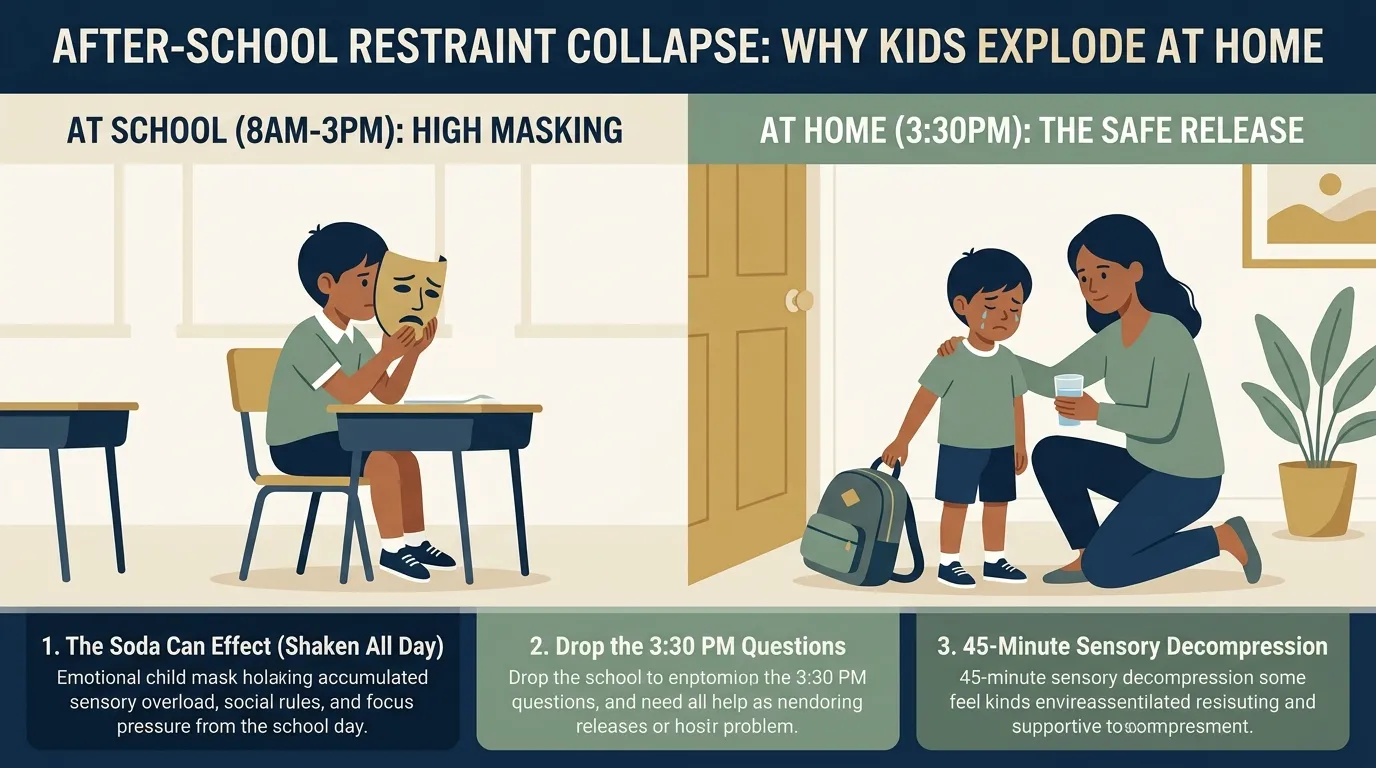
What Is After-School Restraint Collapse?
The Neuroscience: The "Shaken Soda Can" Effect
Imagine your child's nervous system as a sealed can of carbonated soda. Throughout the school day, every minor stressor shakes that can:
- 8:30 AM (Shake 1): Fluorescent classroom lights buzzing, 28 children chattering, and the scratchy seam of their school uniform socks.
- 10:15 AM (Shake 2): Suppressing the urge to fidget, move, or blurt out answers while their ADHD or autistic brain works triple-time to follow verbal instructions.
- 12:30 PM (Shake 3): Navigating the chaotic, echoing cafeteria and decoding exhausting playground social rules without an adult script.
- 2:00 PM (Shake 4): Hiding confusion over a worksheet because they are terrified of looking "stupid" or being corrected in front of peers.
All day long, your child's survival instinct keeps the lid clamped tightly shut. Why? Because the school environment is socially unsafe to fall apart in—falling apart in class means humiliation, peer rejection, or detention.
Then, at 3:15 PM, they see your face at the school gate. Their amygdala registers: "I am finally safe. This person loves me unconditionally." The tab pops—and six hours of pressurized cortisol and adrenaline spray across your car interior.
Take the Free 60-Second Child Development Triage Screener
Not sure if your child's after-school explosions point to high-masking Autism, Inattentive ADHD, or Sensory Overload? Map their exact profile in 6 questions and get a personalized clinical action pathway.
"If my child can control themselves for their teacher, they are choosing to disrespect me at home."
Masking at school is an involuntary survival reflex driven by social fear. Collapsing at home is biological depletion, not a conscious choice to be disrespectful.
"I should punish the 3:30 PM meltdown so they learn to behave at home like they do at school."
Punishing restraint collapse teaches the child that home is also unsafe. Instead of stopping the stress, it forces the child to internalize it into stomachaches, insomnia, or severe school refusal.
"Schools don't need to make accommodations if the child's grades and classroom behavior look fine."
If a child is collapsing for two hours every afternoon, the school environment is exceeding their neurological capacity. Proactive daytime sensory breaks are essential.
The 4-Step '3:30 PM Decompression Protocol'
In my clinical parent consultations, we replace the chaotic afternoon battlefield with a structured 45-Minute Zero-Demand Bridge:
Greet your child with a warm smile and a physical touch, then stop talking. Do not ask "How was your day?", "What did you eat for lunch?", or "Do you have homework?" Every question requires executive retrieval from an empty brain. Say only: "I'm so happy to see you. Snack is on your seat."
Many neurodivergent children barely eat at school due to sensory cafeteria noise or social distraction. Low blood sugar magnifies emotional rage. Have a protein-rich, crunchy snack (apple slices, pretzels, nuts) and a cold drink with a thick straw waiting at pickup. Chewing crunchy foods and sucking through a straw provide heavy oral-motor proprioceptive input that directly calms the vagus nerve.
Suspend household chores at 3:30 PM. Do not demand that shoes be lined up or lunchboxes washed immediately. Allow your child to strip off tight school uniforms, dim the living room lights, and enter a 30-to-45-minute "Sensory Cocoon" (weighted blanket, swinging, Lego play, or listening to a familiar audiobook).
To stop the soda can from exploding at 3:30 PM, we must release pressure at 11:00 AM and 1:30 PM. Work with the teacher or SENCO to build in quiet classroom errands (carrying heavy books to the office), 5-minute quiet corner breaks, or a low-stimulation lunch pass—even if the child never "asks" for one.
Key Takeaways
- After-School Restraint Collapse is a biological stress release after hours of high-effort masking at school.
- Children explode with parents because unconditional attachment safety allows their nervous system to drop its guard.
- Interrogating your child about school or homework at 3:30 PM triggers immediate cognitive overload.
- Crunchy snacks, straw drinking, and 45 minutes of zero-demand sensory rest prevent the afternoon explosion.
- If severe restraint collapse happens daily, a clinical consultation can help uncover hidden ADHD/Autism and secure school accommodations.

Rabbia Ashraf
Clinical Psychologist | Child & Adolescent Development
Rabbia Ashraf is a dedicated Clinical Psychologist specializing in child and adolescent development. She provides parent coaching, developmental guidance, and psychoeducation.
Need Professional Guidance?
Book a consultation with Rabbia Ashraf to discuss your child's development and receive evidence-based recommendations.