
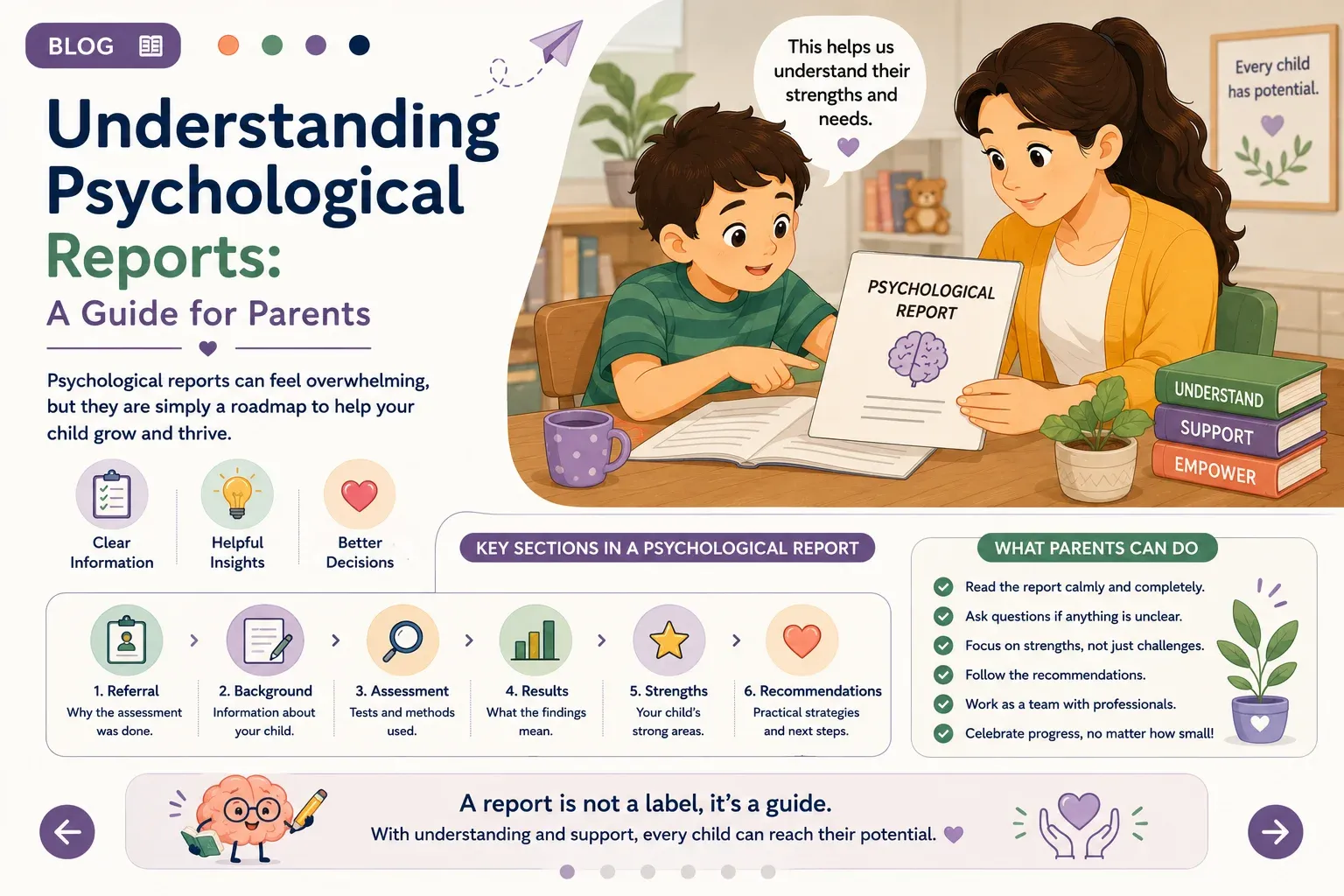
You waited months for the evaluation, attended the testing sessions, and finally received a 15-page psychoeducational report. You open it, see terms like "Working Memory Index," "Processing Speed," and a table showing 16th percentile, and your heart sinks.
The first thought running through almost every parent’s mind is: "Did my child get an F? Does this mean he only scored 16 out of 100?"
In this article you'll learn
- The critical statistical difference between a percentile rank and an exam percentage.
- Why psychological reports are intentionally written in technical clinical jargon.
- How to request a report review or second opinion to translate metrics into plain English.
- How specific subtest scores (working memory, processing speed) dictate school accommodations.
Rule Number One: Percentile Is Not Percentage
A percentile score is not a school grade out of 100. It is a statistical comparison against a carefully standardized normative sample of children of the exact same age and developmental stage.
Scoring in the 16th percentile does not mean your child failed. It means that within that isolated sub-skill, your child performed equal to or higher than 16% of their age cohort. It marks an area that requires specific scaffolding, not an indictment of your child’s intelligence or future potential.
Standardized assessment batteries highlight distinct cognitive strengths alongside accommodation targets.
Why Psychological Reports Feel So Intimidating
Psychological and developmental assessments are written in formal clinical language designed for inter-professional communication (between clinical psychologists, paediatricians, speech therapists, and school authorities). Because the language is clinical, parents often feel alienated and intimidated by their own child's report.
If you feel lost, never hesitate to seek a report review or second opinion with a child psychologist. A 45-minute clinical debrief translates clinical metrics into plain English and answers: "What does this actually mean for my child at 4:00 PM during homework?"
From Diagnostic Scores to Inclusive Classroom Accommodations
The true value of a psychological assessment is not the diagnosis on the final page—it is the detailed breakdown of cognitive domains that forms the blueprint for classroom support:
- Low Working Memory Index: Your child’s brain struggles to hold multi-step verbal instructions in mind. The accommodation: teachers must provide written checklists or break commands down into single steps.
- Low Processing Speed Index: Your child understands the material, but taking information in and writing it down takes longer. The accommodation: 25% extra time on classroom exams and reduced worksheet volume.
- High Verbal Comprehension vs. Lower Fluid Reasoning: Your child has rich spoken concepts but benefits from graphic organizers and visual flowcharts for math and abstract problem-solving.
"If my child has a low processing speed score, it means they have low intelligence."
Processing speed has no correlation with intelligence or creative brilliance. It simply measures how rapidly the motor and visual system outputs information onto paper under time constraints.
Take the recommendations page of the psychological report directly to your school meeting. School inclusion teams and SENCOs rely directly on those clinical bullet points to approve official IEP or 504 classroom accommodations.
Key Takeaways
- Percentile rank is never an exam score out of 100—do not panic.
- Clinical reports are written for practitioners; seek a plain-English report review.
- Cognitive subtest dips are the exact legal basis for school accommodations.
- Use your child's cognitive strengths to scaffold their areas of vulnerability.
Frequently Asked Questions
What if different subtests show huge score differences?
A large discrepancy (a 'spiky profile') is one of the classic hallmarks of neurodivergent learners (such as twice-exceptional, ADHD, or autism). It simply highlights that your child has brilliant cognitive peaks alongside distinct areas that require specific accommodations.
Can an existing report be used to update an IEP or 504 plan?
Absolutely. School inclusion teams and SENCOs rely directly on the clinical recommendations section of these reports to legally justify classroom adjustments.
If you have an evaluation report sitting on your desk that feels confusing or overwhelming, book an online psychological report review. Together, we will turn clinical numbers into an actionable roadmap for home and school.