
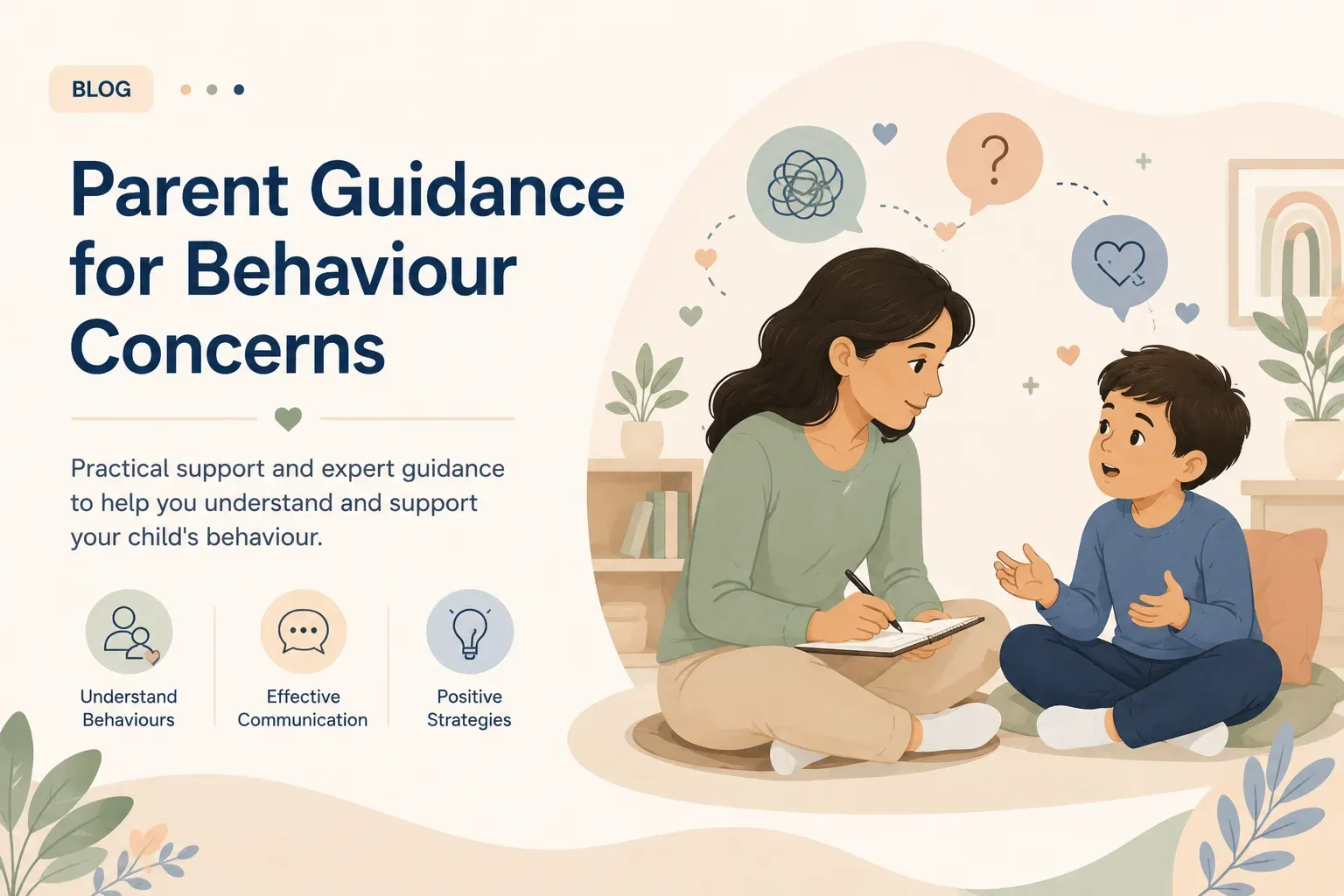
Many parents come to consultation feeling exhausted. They have read the books, tried the sticker charts, and implemented the time-outs, but the challenging behaviour continues. They often ask, "Why won't my child just listen?" The shift begins when we change the question to: "What is my child trying to communicate, and how is my response affecting it?"
What parents usually notice
When families seek parent guidance for behaviour, they usually report cycles of conflict that seem impossible to break. You might notice:
- Escalation: A minor request (like "put your shoes on") quickly turns into a major argument.
- Ineffective Consequences: The child no longer cares if you take away their screen time or toys.
- Walking on Eggshells: You find yourself avoiding setting boundaries because you dread the meltdown that will follow.
- Inconsistency: Because you are exhausted, you sometimes give in just to keep the peace, which sends mixed signals to the child.
What this means: The role of the environment
Behaviour does not happen in a vacuum; it happens in an environment. And in a home, the parents are the primary environment. This doesn't mean parents are to blame for the behaviour. It means parents have the power to change it by altering how they respond.
If a child learns that screaming eventually results in getting what they want (because the parent eventually gives in out of exhaustion), the screaming behaviour is reinforced. Parent guidance focuses on mapping these patterns (the Antecedent, the Behaviour, and the Consequence) and systematically changing the adult's response to break the cycle.
What parents can try at home
Shifting from reactive parenting to proactive parenting takes practice. Here are foundational strategies you can try:
- Respond, Don't React: Take a deep breath before you engage. If you enter the interaction dysregulated, your child will escalate. Your calm presence is required to de-escalate the situation.
- Identify the Function: Ask yourself what the child is getting out of the behaviour. Are they avoiding a difficult task? Seeking connection (even negative connection)? Once you know the 'why', you can teach them a safer way to get that need met.
- Hold the Boundary with Empathy: You can validate a feeling while still enforcing the rule. "I know you are so angry that screen time is over. It is hard to stop playing. But the iPad is going away now."
- Catch Them Being Good: We often only give our children focused attention when they are misbehaving. Make a point to offer specific, positive attention when they are playing quietly or following instructions.
When to seek professional support
If you feel like you are stuck in a negative cycle, if the behaviour is causing significant stress in your family, or if you feel unsupported by traditional parenting advice, parent guidance can provide you with a tailored, evidence-informed plan.
Parents Also Ask
Is this normal behaviour or something more?
If standard parenting strategies are consistently failing, it often indicates the child is missing a skill (like emotional regulation) rather than simply being defiant. We discuss this deeply in Behaviour is Communication.
Can this improve with home strategies?
Yes. In fact, changing the parent's response is the most effective way to change a child's behaviour.
Do I need an assessment?
If the challenging behaviour is accompanied by signs of delayed development, rigid routines, or extreme inattention, an assessment may provide clarity on underlying needs.
Frequently Asked Questions
Does parent guidance mean I am doing a bad job?
Not at all. Seeking parent guidance means you recognise that standard parenting advice isn't working for your unique child. It is a proactive step to learn specialised strategies.
Why doesn't therapy just focus on the child?
Children live in their environment, which is largely managed by their parents. Equipping parents with strategies provides the child with consistent support 24/7, which is far more effective than an hour of therapy a week.
How long does it take to see changes in behaviour?
Behaviour often gets slightly worse before it gets better (an 'extinction burst') as the child tests the new boundaries. However, with consistency, parents usually begin seeing positive shifts within a few weeks.
Related Articles

Rabbia Ashraf
Clinical Psychologist | Child & Adolescent Development
Rabbia Ashraf is a dedicated Clinical Psychologist specializing in child and adolescent development. She provides parent coaching, developmental guidance, and psychoeducation.
Need Professional Guidance?
Book a consultation with Rabbia Ashraf to discuss your child's development and receive evidence-based recommendations.