
Behaviour Is Communication: Decoding What Your Child Needs

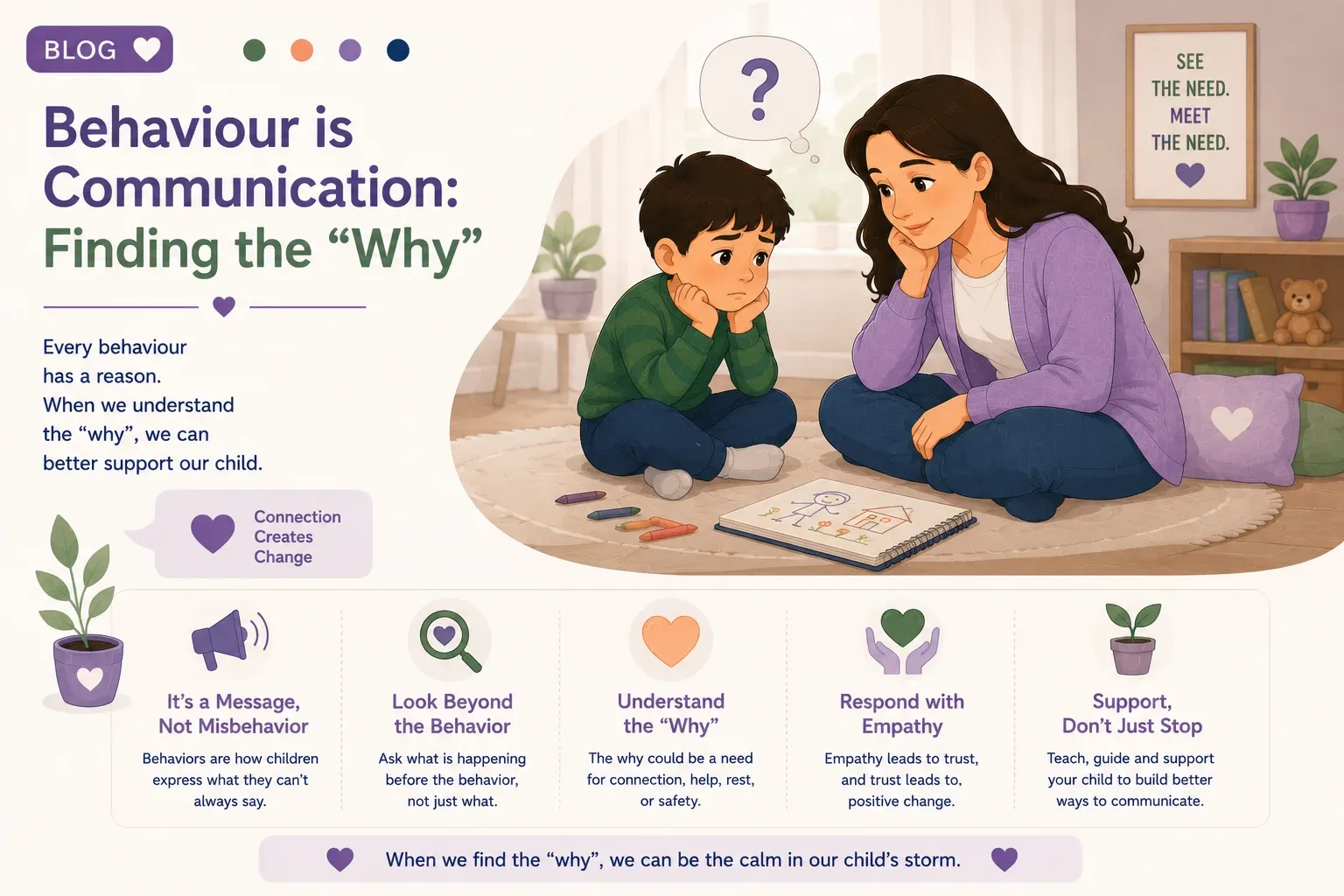
Quick Facts
In this article you'll learn
- The ABC model for understanding behaviour triggers
- The four main reasons children act out
- How to tell the difference between sensory needs and behavioural issues
- Practical strategies to respond to challenging moments
- When to seek professional parent guidance
Changing the Lens on Behaviour
Children, especially those with developmental differences like ADHD, autism, or language delays, often lack the vocabulary or emotional regulation skills to express complex feelings.
When they feel overwhelmed, tired, hungry, or frustrated, they use their bodies and actions to communicate.
Instead of asking, "How do I stop this behaviour?" the better question is, "What is this behaviour trying to tell me?"
The ABCs of Behaviour
Professionals use the "ABC Model" to decode behaviour. You can use this at home, too:
- Antecedent: What happened exactly before the behaviour? (e.g., Mom said it was time to turn off the iPad).
- Behaviour: What did the child do? (e.g., The child screamed and threw a toy).
- Consequence: What happened immediately after? (e.g., Mom gave the child 5 more minutes on the iPad to calm them down).
By tracking the ABCs, you can often identify a pattern that explains why the behaviour keeps happening.
The Four Main Functions of Behaviour
Almost all behaviour serves one of four functions. Understanding these can change how you respond.
1. Escape or Avoidance
The child wants to get out of a non-preferred task or situation. For example, tearing up a worksheet because math is too hard, or running away when asked to brush their teeth.
2. Attention Seeking
The child wants interaction. Even negative attention (like being yelled at) is sometimes better than no attention for a child. This might look like poking a sibling while you are on a phone call.
3. Access to Tangibles
The child wants an item or activity they cannot have right now. A classic example is having a tantrum in the grocery store because they want a candy bar.
4. Sensory Regulation (Automatic)
The behaviour feels good internally or helps the child manage sensory input. This includes rocking, humming, or chewing on clothing. It is not done for attention or escape; it is done for internal regulation.
"If I ignore the bad behaviour, it will just go away."
Ignoring only works if the behaviour is strictly for attention. If a child is acting out to escape homework, ignoring them actually rewards them—they successfully got out of the task!
Sensory vs. Behavioural Needs
It is crucial to differentiate between a behavioural tantrum and a sensory meltdown. A tantrum is driven by a goal (wanting a toy). A meltdown is driven by overload (too much noise, too much stress) and is out of the child's control.
You can negotiate with a tantrum, but you must soothe and reduce demands during a meltdown.
How Parents Can Respond Effectively
Once you identify the function, you can teach the child a better way to communicate.
What Parents Can Do Today
- For Escape: Teach the child to ask for a 'break' using words or a visual card, instead of throwing things.
- For Attention: Provide frequent, proactive positive attention when they are playing nicely. Teach them to tap you and say 'Excuse me'.
- For Tangibles: Use 'First/Then' language. 'First we put away the shoes, then you can have the tablet.'
- For Sensory: Provide appropriate sensory outlets, like a chewy necklace or a quiet tent space, before they become overwhelmed.
When to Seek Professional Support
If challenging behaviour is affecting your family's daily life, causing safety concerns, or if the child is struggling significantly at school, it is time to seek support.
Parent guidance consultations can help you develop a personalized behaviour plan that focuses on teaching new skills rather than just punishing the old ones.
Disclaimer: This article is for educational guidance only and does not replace a professional developmental, psychological, or medical assessment. If you are concerned about your child’s development, behaviour, attention, learning, or communication, it is helpful to consult a qualified professional.
Key Takeaways
- Every challenging behaviour is a form of communication.
- Look at the Antecedent, Behaviour, and Consequence (ABCs) to find patterns.
- Behaviours usually serve one of four functions: Escape, Attention, Tangibles, or Sensory.
- Teach your child a replacement skill (like asking for a break) rather than just punishing.
- Professional parent guidance can provide you with practical, tailored strategies.
Frequently Asked Questions
What does 'behaviour is communication' mean?
It means that children often act out when they cannot find the words or lack the emotional regulation skills to express what they need, such as avoiding a task, seeking attention, or managing sensory overload.
How do I know if my child is acting out for attention or because they are overwhelmed?
Look at the triggers. If the behaviour stops when you give them attention, it's likely attention-seeking. If they continue to be distressed even when comforted or in a quiet room, it may be sensory or emotional overwhelm.
Should I punish my child for challenging behaviour?
Punishment often suppresses behaviour temporarily but doesn't teach a new skill. It is much more effective to understand the function of the behaviour and teach the child a better way to get their needs met (like asking for a break).
Rabbia Ashraf
Clinical Psychologist | Child & Adolescent Development
Rabbia Ashraf is a dedicated Clinical Psychologist specializing in child and adolescent development. She provides parent coaching, developmental guidance, and psychoeducation.
Need Professional Guidance?
Book a consultation with Rabbia Ashraf to discuss your child's development and receive evidence-based recommendations.
Related Articles

Parent Guidance for Behaviour Concerns
When traditional discipline fails, parent guidance helps. Learn how understanding the 'why' behind behaviour and changing your response can transform your home.
Screen Time and Emotional Regulation
Understand the neurological reasons behind screen-time meltdowns and learn practical parent strategies to manage transitions without the battle.
Sleep Routine and Child Behaviour
How sleep impacts behaviour, emotional regulation, and attention, plus practical strategies for better bedtime routines.
Parent Burnout in Child Development Support
Supporting a child with developmental differences is exhausting. Learn why parent burnout happens and how to manage it.
Table of Contents
Related Articles
Parent Guidance for Behaviour Concerns
When traditional discipline fails, parent guidance helps. Learn how understanding the 'why' behind behaviour and changing your response can transform your home.
Screen Time and Emotional Regulation
Understand the neurological reasons behind screen-time meltdowns and learn practical parent strategies to manage transitions without the battle.
Sleep Routine and Child Behaviour
How sleep impacts behaviour, emotional regulation, and attention, plus practical strategies for better bedtime routines.
Parent Burnout in Child Development Support
Supporting a child with developmental differences is exhausting. Learn why parent burnout happens and how to manage it.