
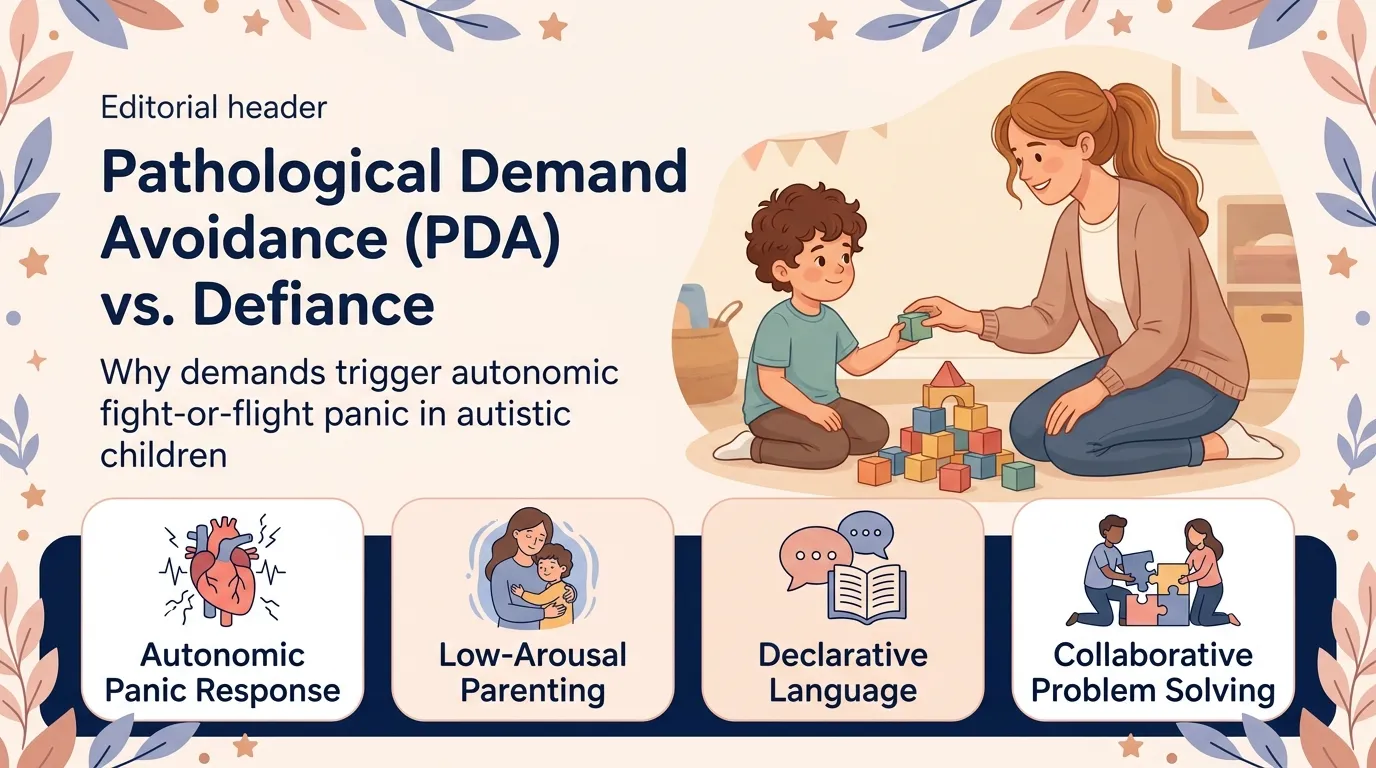
In this article you'll learn
- The fundamental neurological difference between behavioral defiance (ODD) and PDA panic.
- Why rewards, star charts, and consequence-based discipline inevitably fail with PDA.
- How implicit and internal demands (hunger, bladder, fun activities) trigger avoidance.
- The transformative shift from imperative commands to declarative language.
- A 4-pillar low-arousal approach to re-establish collaborative harmony at home.
A Common Household Crisis: It Is Not Stubbornness
Consider this scene, played out in thousands of neurodivergent homes across Singapore, Sri Lanka, the UAE, and the UK:
You announce that it is time to go to the park—an activity your eight-year-old child loves. But within seconds of hearing "Put your jacket on, we're leaving now," your child drops to the floor, screams that they hate the park, claims their legs have turned into stone, or hurls their shoes across the hallway.
To outside observers, relatives, or school staff, this looks like classic defiance, poor boundaries, or Oppositional Defiant Disorder (ODD). Well-meaning friends suggest: "You just need to be firmer. Take away their tablet if they don't listen."
Yet parents of children with Pathological Demand Avoidance (PDA) know the painful truth: clamping down makes the explosive meltdowns ten times worse. Because what looks like refusal on the outside is actually an autonomic survival response on the inside.
The Clinical Definition of PDA
The Neuroscience: Why Demands Feel Like a Physical Threat
In a neurotypical or standard autistic nervous system, a request is processed cognitively. In a PDA nervous system, any perceived demand—whether a direct instruction, an expectation, or even a basic biological urge—is immediately registered by the amygdala as an imminent threat to survival and personal agency.
When someone issues a command ("Wash your hands"), the child's autonomic nervous system perceives an acute loss of control. The brain floods with cortisol and adrenaline, catapulting the child into a fight-or-flight crisis:
🥊 Fight / Resistance Defense
Shouting, physical aggression, throwing objects, extreme verbal arguments, or swearing. These are not willful insults; they are desperate attempts to neutralize an intolerable perceived threat.
🏃 Flight / Avoidance Defense
Running away, hiding under beds, distracting conversations, making jokes, mimicking characters, or claiming physical paralysis ("My legs won't work!").
🧊 Freeze / Shutdown Defense
Selective silence, blank stares, curling into a ball, or dissociation where the child becomes completely unreachable and unresponsive to sensory cues.
🕊️ Fawn / Social Masking Defense
Over-agreeing, extreme pleasing, adopting adult personas, or masking at school only to explode in extreme violent exhaustion upon returning home.
Why Traditional Parenting & Behaviorism Make PDA Worse
Most parenting frameworks, school behavioral policies, and even conventional ABA therapy are built upon the premise of hierarchy and external motivation: adult gives order, child complies, child gets reward; or child refuses, adult enforces consequence.
With PDA, this model is catastrophic for three reasons:
- 1. Praise is a Demand: Saying "Good job eating all your peas! Let's do that tomorrow too!" immediately turns tomorrow's meal into a heavy expectation, ensuring the child will reject peas tomorrow.
- 2. Rewards Trigger Coercion Alarm: The moment a child realizes a sticker or treat is being used to control their behavior, their threat system detects manipulation and rejects the entire exchange.
- 3. Consequences Confirm Unsafe Hierarchy: Punishments and loss of privileges deepen feelings of helplessness and isolation, driving baseline anxiety higher and making future cooperation even more impossible.
"PDA children are just manipulating their parents to get their own way."
PDA is an involuntary neuro-biological threat response. The child avoids things they genuinely love (parties, gaming, eating their favorite food) because the demand itself triggers panic.
"Giving choices and lowering demands will spoil the child."
Lowering unnecessary demands builds genuine autonomic regulation and relational safety. Once anxiety drops, PDA children naturally cooperate and thrive.
"PDA is just Oppositional Defiant Disorder (ODD)."
ODD is characterized by defiance against authority figures. PDA is driven by an internal need to avoid ALL demands—including internal biological needs like drinking water or going to the bathroom.
The P-A-N-D-A Low-Arousal Framework for Parents
The PDA Society in the UK developed the evidence-backed P-A-N-D-A guidelines, which form the cornerstone of our clinical family consultations:
Distinguish between non-negotiables (immediate physical safety) and negotiable preferences (wearing matching socks, sitting at the dining table, brushing teeth at the exact same minute). Ruthlessly drop non-essential demands to lower baseline nervous system load.
Recognize that meltdowns are panic attacks. Treat defiance as terror. Lower your vocal pitch, step back physically, avoid direct eye contact, and provide soothing sensory regulation before attempting to address the task.
Treat the child as an equal partner. Use Ross Greene's Collaborative & Proactive Solutions model: "I noticed we need to leave in ten minutes, but you're deeply immersed in your drawing. How can we make the transition work?"
Replace imperative commands ("Put your coat on") with non-directive declarative statements: "I'm feeling quite chilly outside today," or "I wonder if coats are in the hallway." Declarative statements invite curiosity rather than triggering demand avoidance.
Remain flexible. If an agreed strategy stops working on a high-stress day, pivot without frustration. Humor, novelty, and playfulness are your strongest tools to bypass perceived demands.
Key Takeaways
- Pathological Demand Avoidance (PDA) is driven by autonomic threat activation, not malicious stubbornness.
- Traditional behavioral therapies, reward charts, and punishments increase panic and escalate explosive meltdowns.
- Demands include daily personal care, schoolwork, praise, and even internal urges like eating and using the restroom.
- Declarative language, humor, and collaborative negotiation allow PDA children to preserve their autonomy safely.
- Comprehensive clinical consultations help parents establish low-arousal accommodations tailored to home and school.

Rabbia Ashraf
Clinical Psychologist | Child & Adolescent Development
Rabbia Ashraf is a dedicated Clinical Psychologist specializing in child and adolescent development. She provides parent coaching, developmental guidance, and psychoeducation.
Need Professional Guidance?
Book a consultation with Rabbia Ashraf to discuss your child's development and receive evidence-based recommendations.