
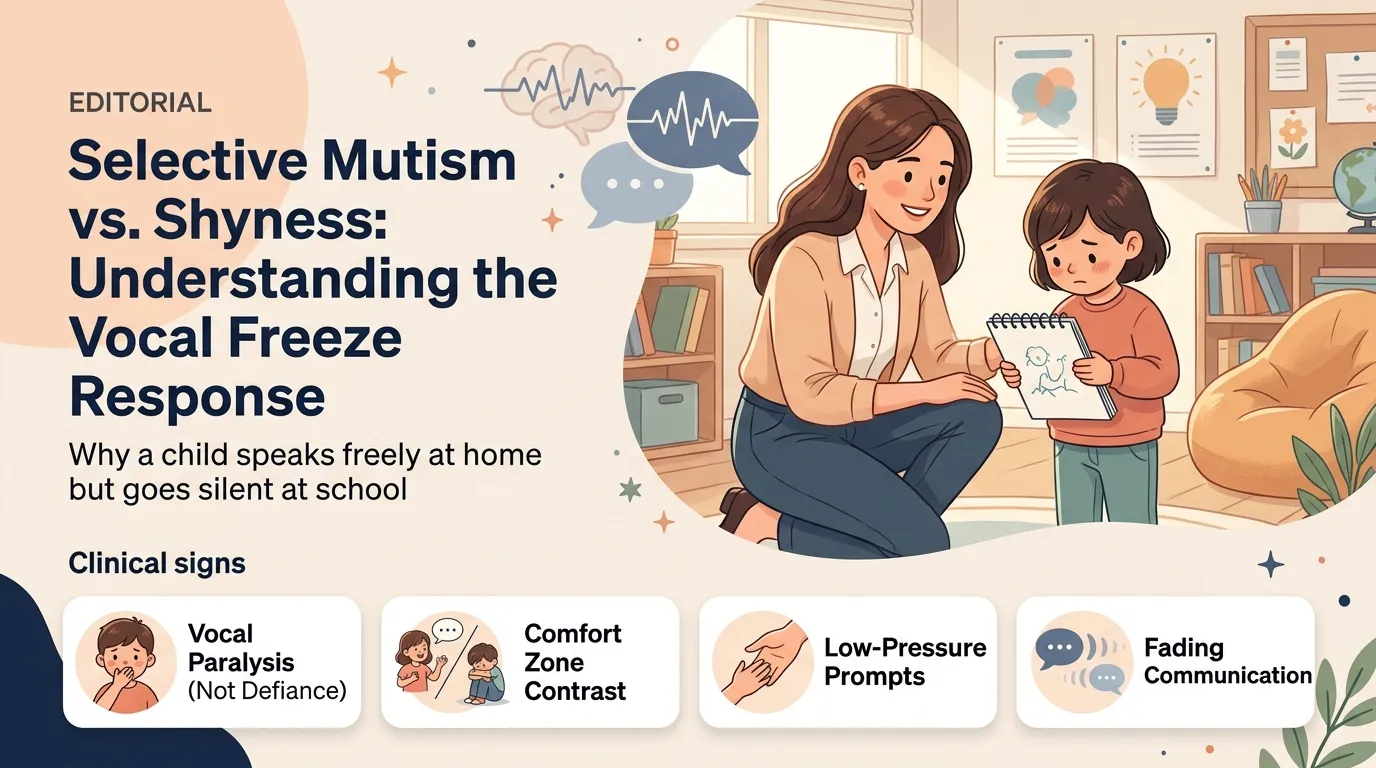
At home, your six-year-old is a non-stop chatterbox—cracking jokes, singing songs, reciting stories, and speaking in complex sentences. But the moment they step across the school threshold or enter a relative's living room, a heavy silence descends.
Their posture stiffens, their gaze drops to the floor, and when a teacher asks a simple question like "Did you have a good weekend?", the child stands completely frozen—unable to utter even a single syllable or whisper.
Relatives say, "They're just playing shy, leave them be." Teachers may note, "She is choosing not to speak to control the classroom." But in clinical psychology, this drastic contrast points to a severe, misunderstood anxiety condition: Selective Mutism (SM).
In this article you'll learn
- The stark neurological differences between ordinary shyness and Selective Mutism.
- Why telling a frozen child to 'just use your words' exacerbates the vocal freeze.
- How the autonomic nervous system physically locks vocal cord engagement.
- The clinical 'Stimulus Fading' framework for building communication bridges at school.
Crucial Clinical Distinction: Freeze, Not Defiance
Selective Mutism is not an oppositional behavior. The child is not withholding their voice out of stubbornness, defiance, or spite.
SM is an autonomic freeze response. When social performance demands exceed the child's coping threshold, the amygdala signals acute danger. The child's vocal cords and throat muscles involuntarily tighten. Asking an SM child to speak in front of a class feels as terrifying as asking someone with severe arachnophobia to hold a tarantula.
Shyness vs. Selective Mutism: Key Differences
| Characteristic | Developmentally Typical Shyness | Selective Mutism (SM) |
|---|---|---|
| Comfort Over Time | Warms up after 15–30 minutes and begins talking. | Remains mute for months or entire school terms. |
| Non-Verbal Gestures | Nods, points, smiles, makes warm eye contact. | Frozen posture, blank facial expression, avoids eye contact. |
| Home vs. School | Slightly more reserved outside, but generally consistent. | Extreme discrepancy: vibrant chatterbox at home, mute outside. |
| Response to Direct Question | Whispers or answers quietly with gentle encouragement. | Completely paralyzed; throat constricts under pressure. |
Gentle co-regulation and predictable sensory safety are the prerequisites for unlocking speech.
What Never to Say to a Child with Selective Mutism
"Saying: 'Just say hello, the cat didn't get your tongue!' helps coax them out of their shell."
Direct verbal demands put the spotlight squarely on the child, spiking cortisol and reinforcing the panic freeze loop. Never draw public attention to their silence.
"They talk to mom and dad, so they can talk to the teacher if they just try harder."
SM is context-bound. Speech is unlocked only in environments with zero perceived social threat. The presence of unfamiliar peers or performance expectations triggers the nervous system freeze.
"Answering for them permanently fixes the awkwardness."
While swooping in instantly rescues them from panic, it also accidentally teaches the child that silence is the only escape. Instead, bridge the interaction through low-pressure non-verbal gestures.
Three Clinical Strategies to Build Communication Bridges
- 1. Shift to Non-Verbal Participation First:In the classroom, allow the child to participate using individual dry-erase whiteboards, thumbs-up/thumbs-down signals, pointing, or handing the teacher a printed card. Acknowledging participation without demanding sound establishes safety.
- 2. The 'Sliding In' (Stimulus Fading) Technique:Arrange for the parent to visit an empty classroom after school hours. The child plays and talks loudly with the parent. The teacher stands outside in the hallway, then slides into the doorway, then into the corner, gradually fading their presence into the child's comfort bubble without demanding interaction.
- 3. Forced-Choice and Declarative Prompts:Avoid open-ended questions like "What did you draw today?" Instead, use declarative comments: "I notice you used bright green for the leaves. You can point to which crayon was your favorite."
Key Takeaways
- Selective Mutism is a severe vocal freeze anxiety disorder, not oppositional defiance or bad manners.
- The drastic difference between talkative home behavior and school silence is the diagnostic hallmark.
- Pressuring or pleading with the child spikes autonomic panic and deepens the freeze response.
- School accommodations must incorporate non-verbal answering options and stimulus fading techniques.
- A structured parent-school consultation roadmap unlocks progress faster than waiting for the child to 'grow out of it'.

Rabbia Ashraf
Clinical Psychologist | Child & Adolescent Development
Rabbia Ashraf is a dedicated Clinical Psychologist specializing in child and adolescent development. She provides parent coaching, developmental guidance, and psychoeducation.
Need Professional Guidance?
Book a consultation with Rabbia Ashraf to discuss your child's development and receive evidence-based recommendations.