
Homework Battles and Attention Difficulties: How to Help Your Child Focus

Quick Facts
In this article you'll learn
- The reality of 'attention fatigue' after a long school day
- How to tell the difference between laziness and a learning difficulty
- Practical strategies to structure homework for the ADHD brain
- How to use 'body doubling' to support focus
- When it is time to seek a formal educational assessment
The Reality of Attention Fatigue
Imagine doing your taxes for six hours straight in a loud, bright room where you also have to manage complex social politics. That is what a school day feels like for a child, especially a child with ADHD or a learning difficulty.
By the time they get home, their "attention tank" is completely empty. This is called attention fatigue. Asking them to immediately sit down and do a math worksheet is neurologically exhausting for them.
Task Avoidance vs. Inability
When a child cries, throws their pencil, or says "This is stupid," parents often assume the child is just being defiant.
However, avoidance is usually a protective mechanism. If a task feels impossible (due to an undiagnosed reading issue, poor working memory, or extreme fatigue), the child's brain will actively fight starting it to protect them from the pain of failure.
"If they can focus on video games for hours, they can focus on homework."
Video games provide constant, immediate dopamine rewards. Homework provides zero immediate dopamine. A brain with ADHD naturally gravitates toward the high-dopamine task and struggles to initiate the low-dopamine task.
How to Structure Homework for Success
If you want to end the battles, you must change the environment and the structure of the task.
What Parents Can Do Today
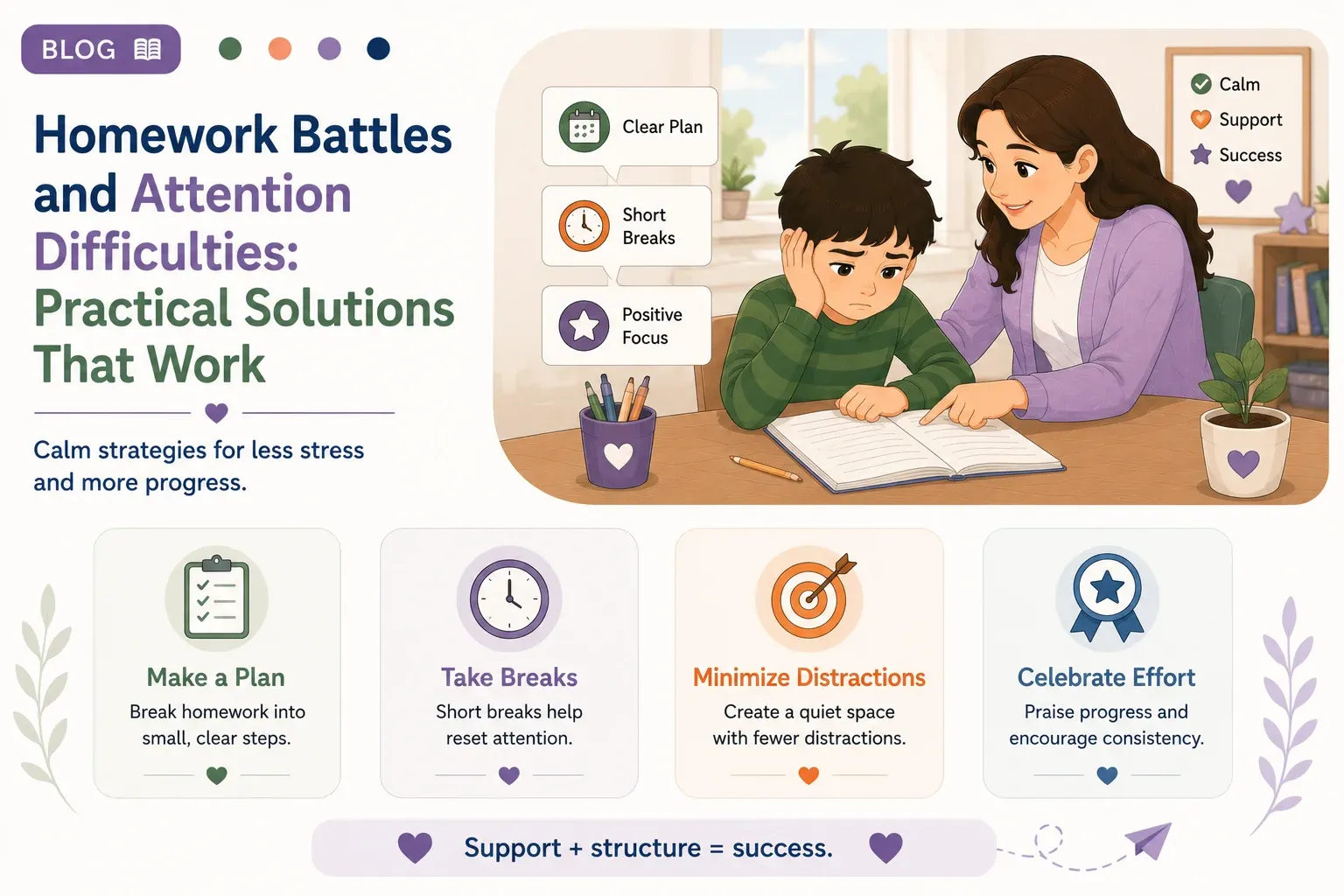
- Break it down: Do not give them a whole page of math problems. Cut the paper in half, or cover the bottom half with a blank sheet. A smaller visual field is less overwhelming.
- Use the Pomodoro Technique: Work for 15 minutes, then take a mandatory 3-minute movement break. Use a visual timer so they can see the finish line.
- Body Doubling: Simply sit quietly next to them while you read a book or answer emails. Your calm, focused presence helps regulate their nervous system.
- Offer choices: 'Do you want to do spelling first or math first?' Giving them control over the process reduces resistance.
The Role of Executive Function
Homework requires massive executive functioning skills: estimating time, organizing materials, initiating a boring task, and remembering instructions. Children with ADHD are often 3 to 5 years delayed in these skills compared to their peers.
You cannot discipline a child into having better executive function. You must provide external scaffolding (like checklists and timers) until their brain matures enough to handle it internally.
When to Seek an Assessment
If you have optimized the environment, provided breaks, and offered support, but your child is still consistently unable to learn the material, it is time for a formal assessment.
A psychoeducational assessment can determine if there is an underlying Specific Learning Disorder (like Dyslexia or Dyscalculia) or if the core issue is ADHD. Once you have data, you can ask the school for appropriate accommodations, such as reduced homework loads or assistive technology.
Disclaimer: This article is for educational guidance only and does not replace a professional developmental, psychological, or medical assessment. If you are concerned about your child’s development, behaviour, attention, learning, or communication, it is helpful to consult a qualified professional.
Key Takeaways
- After a long school day, children suffer from 'attention fatigue' and need a brain break.
- Homework avoidance is usually a sign that the task feels neurologically overwhelming.
- Break tasks down into visually smaller chunks to reduce anxiety.
- Use visual timers and frequent, structured movement breaks.
- If the struggle persists despite support, a psychoeducational assessment is necessary.
Frequently Asked Questions
Why does a 10-minute worksheet take my child two hours?
This usually happens due to a mix of task avoidance, poor executive functioning, and attention fatigue. If the brain perceives the task as too hard or too boring, it will actively resist starting or finishing it.
Should my child do their homework right after school?
Not necessarily. Most children, especially those with ADHD or learning difficulties, need a 'brain break' after the intense focus required at school. Provide a snack and some physical movement before starting homework.
What is the 'Body Double' technique?
Body doubling is a strategy where a parent sits quietly in the same room, perhaps reading a book or working on a laptop, while the child does their homework. The calm, focused presence of the adult helps regulate the child's nervous system and keeps them on task.
Rabbia Ashraf
Clinical Psychologist | Child & Adolescent Development
Rabbia Ashraf is a dedicated Clinical Psychologist specializing in child and adolescent development. She provides parent coaching, developmental guidance, and psychoeducation.
Need Professional Guidance?
Book a consultation with Rabbia Ashraf to discuss your child's development and receive evidence-based recommendations.
Related Articles

Morning Routine Problems in ADHD
Mornings are often the hardest part of the day for families with ADHD. Understand the executive function struggles behind morning chaos and learn practical parent strategies.

IEP and School Support Planning
A guide for parents on how to navigate IEP meetings and ensure their child receives the right support.

School Meeting Checklist
Don't go into a school meeting unprepared. Use this checklist to organize your thoughts, ask the right questions, and secure practical accommodations.

School Refusal and School Anxiety
When a child refuses to go to school, it is a sign of intense anxiety, not defiance. Learn how to support your child and communicate with the school.
Table of Contents
Related Articles
Morning Routine Problems in ADHD
Mornings are often the hardest part of the day for families with ADHD. Understand the executive function struggles behind morning chaos and learn practical parent strategies.
IEP and School Support Planning
A guide for parents on how to navigate IEP meetings and ensure their child receives the right support.
School Meeting Checklist
Don't go into a school meeting unprepared. Use this checklist to organize your thoughts, ask the right questions, and secure practical accommodations.
School Refusal and School Anxiety
When a child refuses to go to school, it is a sign of intense anxiety, not defiance. Learn how to support your child and communicate with the school.