
School Meeting Checklist: How to Prepare for an IEP or Parent-Teacher Conference

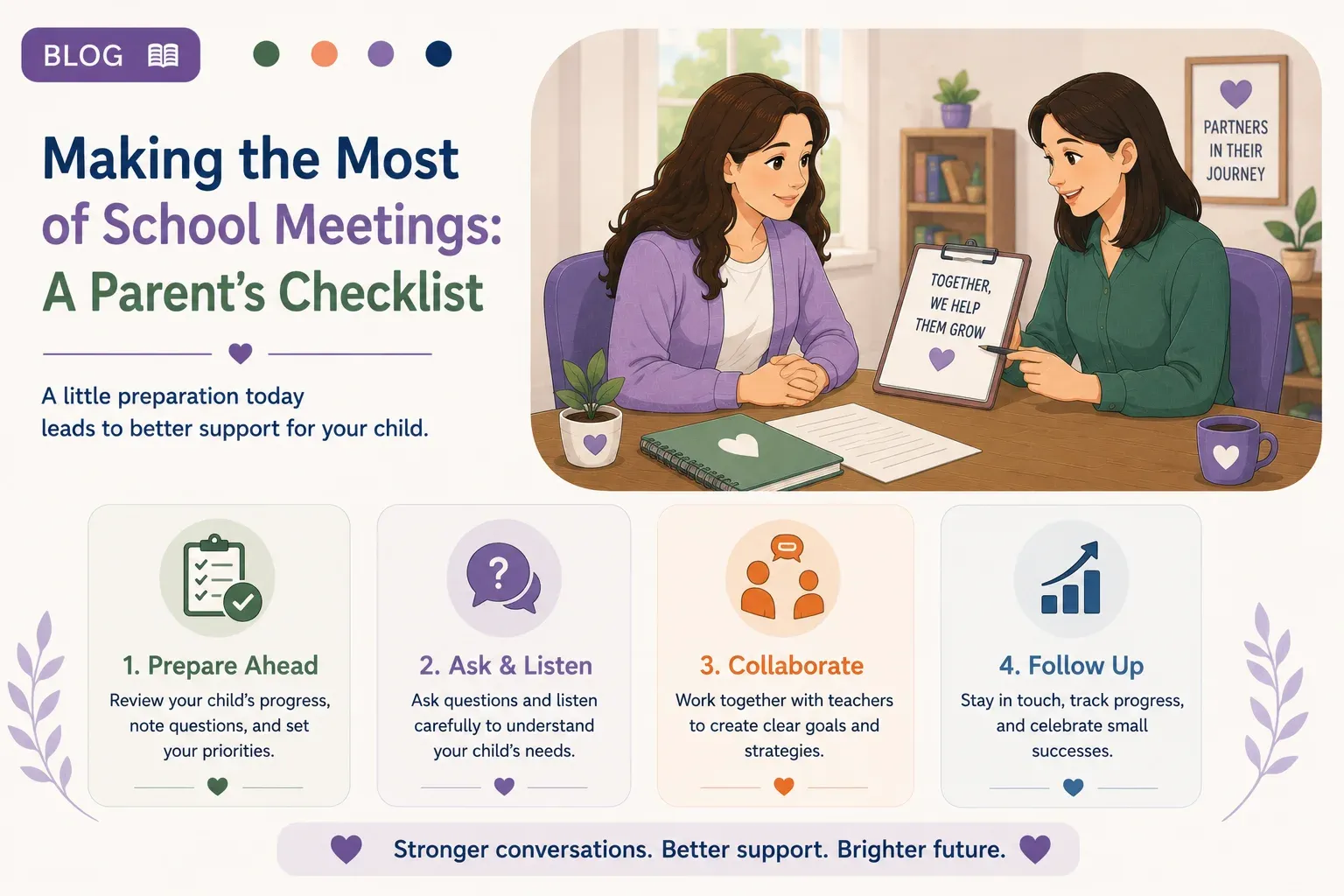
Quick Facts
In this article you'll learn
- How to prepare documentation before the meeting
- Strategies for staying focused and collaborative during the meeting
- Key questions to ask teachers and staff
- What to do if your child 'masks' at school but struggles at home
- Follow-up steps to ensure the plan is put into action
Before the Meeting
Preparation is the key to a successful meeting. Do not wait until you sit down to figure out what you want to say.
What Parents Can Do Today
- Review the previous IEP or report card. Note any goals that have or haven't been met.
- Write down your top 2-3 concerns. Prioritize these, as meeting time is usually limited.
- Gather your documents. Bring copies of any recent psychological assessments, medical reports, or private therapy summaries.
- Write down your child's strengths. It is important to start the conversation by focusing on what your child does well.
During the Meeting
It is easy to get emotional when discussing your child's challenges. Keep the focus on collaboration and data.
Start with the positive: Acknowledge the teacher's hard work and highlight a positive experience your child had in their class.
Address the 'Masking' phenomenon: If the teacher says, "They are fine at school," but your child is having meltdowns at home, explain this. Say, "It takes all their energy to hold it together during the day, which means they are exhausted and overwhelmed by the time they get home. How can we reduce their cognitive or sensory load at school?"
"I shouldn't ask for too much or the teacher will be annoyed."
Teachers want their students to succeed. Providing clear, practical strategies (like 'He needs a 2-minute break before writing tasks') is much more helpful than leaving the teacher to guess what works.
Questions to Ask
Do not just listen; actively guide the conversation to get actionable answers.
- "What does this behaviour look like in the classroom?"
- "What strategies have you already tried, and what was the result?"
- "How can we mirror the school's successful strategies at home?"
- "If my child becomes overwhelmed, what is the clear plan for them to take a break?"
- "How will we measure progress on this issue over the next month?"
After the Meeting
The meeting is only the first step. The follow-up is where change happens.
Send a brief, polite email to the teacher summarizing what was agreed upon. For example: "Thank you for meeting today. To confirm our plan, we agreed that Sarah will be allowed to use noise-canceling headphones during independent reading, and I will check her planner every night."
When to Seek Professional Support
If you feel the school is not understanding your child's needs, or if the current plan is not working, it may be time for a formal psychological assessment or a school consultation service.
A clinical psychologist can review the school reports, assess the child, and provide a clinical report with legally and educationally sound recommendations for accommodations.
Disclaimer: This article is for educational guidance only and does not replace a professional developmental, psychological, or medical assessment. If you are concerned about your child’s development, behaviour, attention, learning, or communication, it is helpful to consult a qualified professional.
Key Takeaways
- Prepare your top 2-3 concerns before the meeting starts.
- Bring recent psychological reports and data to support your requests.
- Focus on collaborative problem-solving, not confrontation.
- Address 'masking' if the child is fine at school but exhausted at home.
- Always send a follow-up email summarizing the agreed-upon plan.
Frequently Asked Questions
What should I bring to a school meeting or IEP?
Bring any recent psychological or medical reports, a list of your child's strengths, a summary of your main concerns, and a notepad to take notes during the meeting.
How can I make sure my child's needs are heard by the teacher?
Keep the focus collaborative rather than confrontational. Share specific examples of what you see at home, and ask the teacher what they are seeing in the classroom. Use phrases like, 'How can we work together to support this?'
What if the school says my child is doing fine, but they struggle at home?
This is very common. Many children 'mask' or hold it together during the school day and melt down at home. Explain this pattern to the teacher and request accommodations that reduce the cognitive or sensory load during the day.
Rabbia Ashraf
Clinical Psychologist | Child & Adolescent Development
Rabbia Ashraf is a dedicated Clinical Psychologist specializing in child and adolescent development. She provides parent coaching, developmental guidance, and psychoeducation.
Need Professional Guidance?
Book a consultation with Rabbia Ashraf to discuss your child's development and receive evidence-based recommendations.
Related Articles

IEP and School Support Planning
A guide for parents on how to navigate IEP meetings and ensure their child receives the right support.
Homework Battles and Attention Difficulties
Why homework is a battleground for children with attention difficulties and how parents can help.
School Refusal and School Anxiety
When a child refuses to go to school, it is a sign of intense anxiety, not defiance. Learn how to support your child and communicate with the school.
Learning Difficulties Early Signs
Learn how to spot the early signs of learning difficulties, like dyslexia or dyscalculia, and how to advocate for your child at school.
Table of Contents
Related Articles
IEP and School Support Planning
A guide for parents on how to navigate IEP meetings and ensure their child receives the right support.
Homework Battles and Attention Difficulties
Why homework is a battleground for children with attention difficulties and how parents can help.
School Refusal and School Anxiety
When a child refuses to go to school, it is a sign of intense anxiety, not defiance. Learn how to support your child and communicate with the school.
Learning Difficulties Early Signs
Learn how to spot the early signs of learning difficulties, like dyslexia or dyscalculia, and how to advocate for your child at school.