
School Refusal and School Anxiety: When Mornings Become a Battle

Quick Facts
In this article you'll learn
- The difference between truancy and school refusal
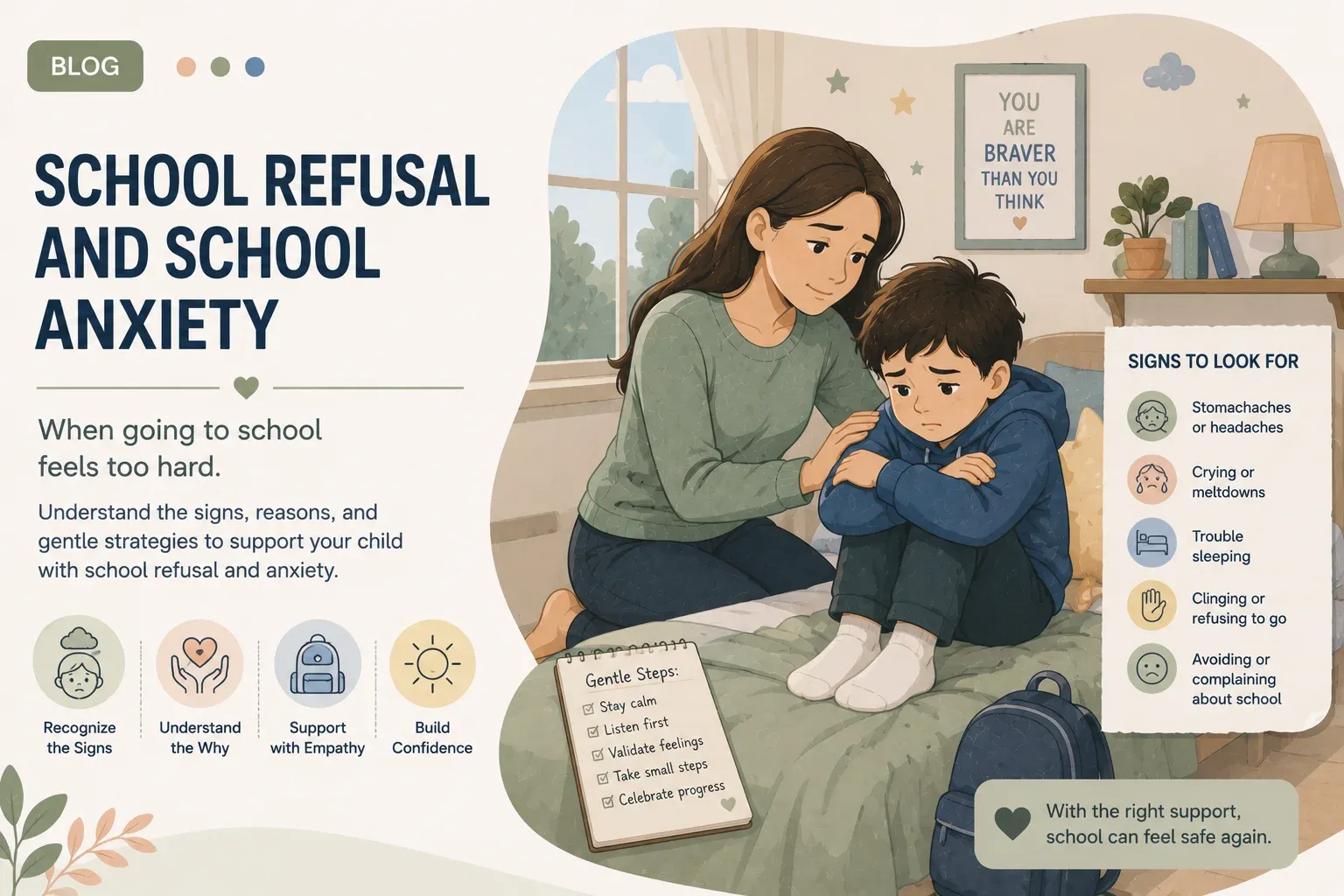
- How anxiety manifests physically in children
- The hidden root causes of school avoidance
- Why letting them stay home can sometimes make anxiety worse
- Practical steps parents can take to ease morning transitions
What is School Refusal?
School refusal (often clinically termed "emotionally based school avoidance") is very different from truancy. A truant child skips school without their parents' knowledge to do something they find more fun.
A child experiencing school refusal is usually at home, with their parents' knowledge, experiencing intense distress and anxiety about attending school.
Common Root Causes
Children do not refuse school for no reason. There is almost always a root cause making the school environment feel unsafe or overwhelmingly difficult.
- Separation Anxiety: Common in younger children, the fear of being away from a parent or caregiver.
- Social Anxiety or Bullying: Fear of judgment by peers, feeling isolated, or actively being bullied.
- Undiagnosed Learning Difficulties: If a child is secretly struggling to read or do math, school feels like a daily public failure. Avoidance is their defense mechanism.
- Sensory Overload: For children with autism or ADHD, the noise, crowds, and fluorescent lights of a school can be physically painful and exhausting.
The Anxiety Cycle
When a child is terrified of school and you finally say, "Okay, you can stay home today," their anxiety immediately drops. This drop in anxiety feels like a massive reward to the brain.
However, the next day, the anxiety returns even stronger because the brain learned that avoidance is the only way to feel safe. Over time, missing school leads to falling behind on work and losing touch with friends, making returning even more terrifying. This is the anxiety cycle.
"They just need to be punished for refusing to go."
Punishing a child for severe anxiety usually escalates their distress and damages their trust in you. Support and problem-solving work better than punishment.
What Parents Can Do
Breaking the cycle of school refusal requires a team effort between the parents, the child, and the school.
What Parents Can Do Today
- Identify the trigger: Talk to your child during a calm moment (not the morning rush) to find out what exactly is making school hard.
- Collaborate with the school: Set up a meeting with the teacher and counselor. Do not hide the problem. Ask if the child can have a 'soft landing' (e.g., arriving 10 minutes early to read quietly in the library).
- Maintain home boundaries: If the child must stay home, it should not be a 'fun' day. No screens, no video games during school hours. Make home boring but safe.
- Break it down: If a full day is too much, aim for a partial day, or even just driving to the school parking lot to build tolerance.
When to Seek Professional Support
If school refusal has lasted for more than a couple of weeks, or if it is accompanied by severe depression or self-harm, professional intervention is necessary.
A clinical psychologist can provide a psychological assessment to uncover hidden learning or neurodevelopmental issues, and work with the family to create a structured return-to-school plan.
Disclaimer: This article is for educational guidance only and does not replace a professional developmental, psychological, or medical assessment. If you are concerned about your child’s development, behaviour, attention, learning, or communication, it is helpful to consult a qualified professional.
Key Takeaways
- School refusal is driven by intense anxiety or overwhelm, not defiance.
- Physical symptoms like stomach aches are often how anxiety shows up in the body.
- Look for root causes: bullying, learning difficulties, or sensory overload.
- Allowing avoidance temporarily relieves anxiety but makes the long-term problem worse.
- Collaborate closely with the school to create a safe, gradual return plan.
Frequently Asked Questions
Is school refusal just a child being stubborn?
No. School refusal is usually driven by severe anxiety, an undiagnosed learning difficulty, or sensory overwhelm. It is a distress response, not deliberate defiance.
What should I do if my child complains of a stomach ache every morning?
First, rule out actual illness with a doctor. If they are physically healthy, recognize that anxiety often manifests physically in children as stomach aches or headaches. Acknowledge the feeling without letting them stay home just to avoid the anxiety.
Should I force my child into the car?
Physical force usually escalates anxiety and damages trust. Instead, focus on small steps (like just getting dressed) and collaborate with the school to make arrival less overwhelming.
Rabbia Ashraf
Clinical Psychologist | Child & Adolescent Development
Rabbia Ashraf is a dedicated Clinical Psychologist specializing in child and adolescent development. She provides parent coaching, developmental guidance, and psychoeducation.
Need Professional Guidance?
Book a consultation with Rabbia Ashraf to discuss your child's development and receive evidence-based recommendations.
Related Articles
Homework Battles and Attention Difficulties
Why homework is a battleground for children with attention difficulties and how parents can help.

IEP and School Support Planning
A guide for parents on how to navigate IEP meetings and ensure their child receives the right support.
School Meeting Checklist
Don't go into a school meeting unprepared. Use this checklist to organize your thoughts, ask the right questions, and secure practical accommodations.
Learning Difficulties Early Signs
Learn how to spot the early signs of learning difficulties, like dyslexia or dyscalculia, and how to advocate for your child at school.
Table of Contents
Related Articles
Homework Battles and Attention Difficulties
Why homework is a battleground for children with attention difficulties and how parents can help.
IEP and School Support Planning
A guide for parents on how to navigate IEP meetings and ensure their child receives the right support.
School Meeting Checklist
Don't go into a school meeting unprepared. Use this checklist to organize your thoughts, ask the right questions, and secure practical accommodations.
Learning Difficulties Early Signs
Learn how to spot the early signs of learning difficulties, like dyslexia or dyscalculia, and how to advocate for your child at school.