
Learning Difficulties: Early Signs Parents Need to Notice

Quick Facts
In this article you'll learn
- Why avoidance is usually a sign of a learning block, not laziness
- Specific signs of reading and writing difficulties (like Dyslexia)
- Specific signs of math and memory difficulties (like Dyscalculia)
- The deep emotional impact of unsupported learning differences
- Why and when to seek a psychoeducational assessment
It is Rarely Just "Laziness"
Developmental psychology tells us a fundamental truth: children generally want to do well. They want to please their teachers, make their parents proud, and feel smart among their peers.
When a child actively avoids a task, it is almost always because the task is causing them cognitive pain or frustration. A child who refuses to read out loud is not being defiant; they are likely trying to hide the fact that the words on the page don't make sense to their brain.
Early Signs in Reading and Spelling
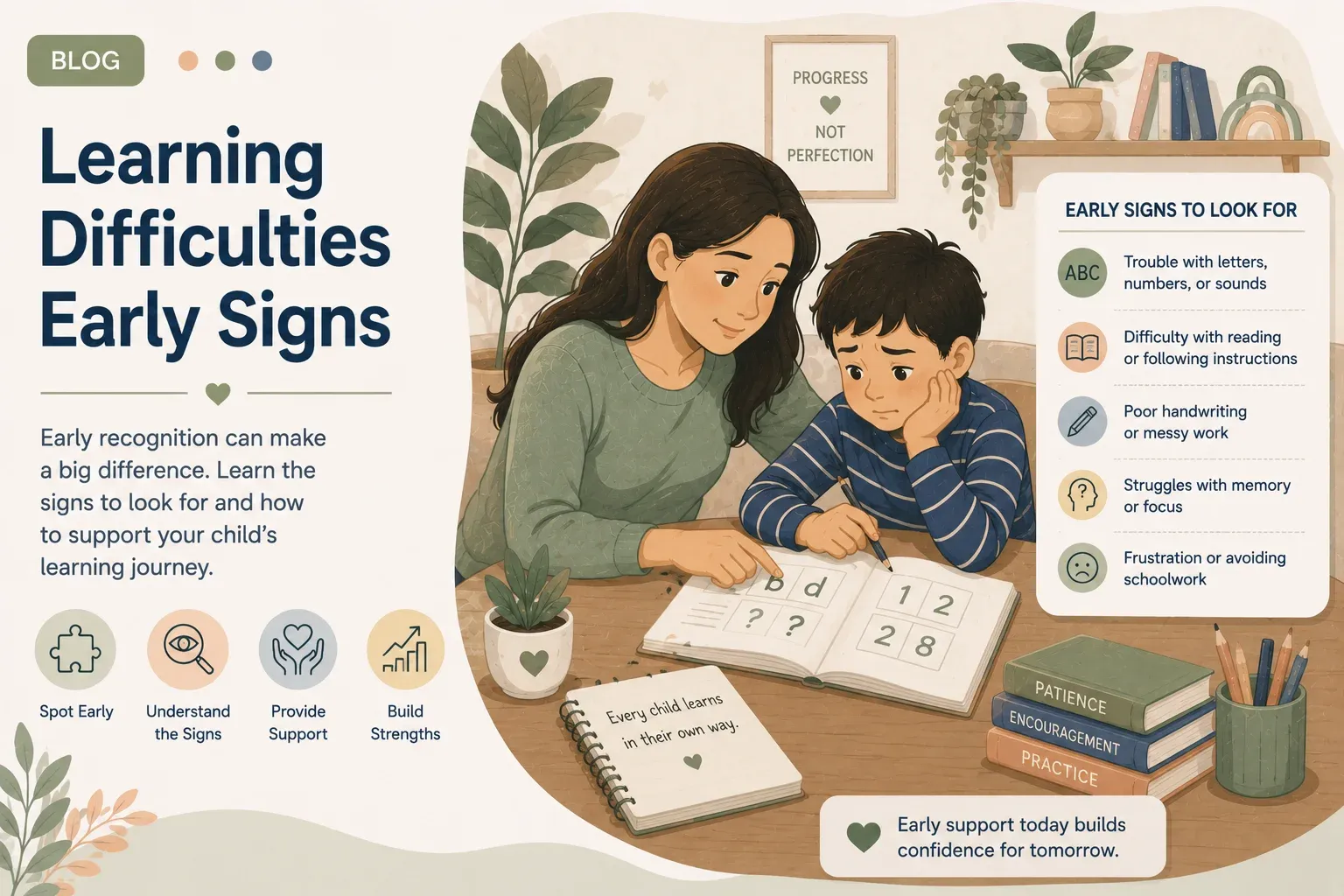
Specific Learning Disorders in reading (often called Dyslexia) and writing (Dysgraphia) are among the most common.
Look out for these signs beyond the age of 7:
- Guessing words: Instead of sounding out a word, they guess based on the first letter or the picture on the page.
- Poor phonemic awareness: Struggling to recognize rhyming words or break a word down into individual sounds.
- Letter reversals: Confusing "b" and "d" or "p" and "q" consistently past early primary school.
- Exhaustion: Reading a short paragraph takes immense effort, leaving them too tired to remember what the paragraph was actually about.
Early Signs in Math and Memory
A Specific Learning Disorder in mathematics (often called Dyscalculia) affects a child's fundamental "number sense."
- No concept of time or quantity: Struggling to estimate how long a minute is, or whether 10 is bigger than 5 without counting.
- Relying on fingers: Continuing to use fingers for very basic addition well beyond the age their peers have memorized the facts.
- Working memory limits: They might understand a math concept perfectly on Tuesday, but by Thursday, it is completely erased from their memory.
"They just need more tutoring after school to catch up."
If a child has a neurological learning difficulty, doing 'more of the same' will not work and only causes burnout. They need specialized, evidence-based teaching methods, not just extra volume.
The Emotional Toll of Learning Difficulties
Perhaps the most devastating sign of a learning difficulty is the emotional impact. Children look around the classroom and see their peers finishing tasks quickly.
Without an explanation for why their brain works differently, children internalize the struggle. This leads to severe school anxiety, school refusal, and a deeply damaged self-esteem.
When to Seek an Educational Assessment
If your child is consistently falling behind academic benchmarks, or if the emotional toll of homework is destroying your family evenings, it is time for a formal psychoeducational assessment.
What Parents Can Do Today
- Speak to the teacher: Ask them specifically where the breakdown is happening (e.g., Is it reading the words, or understanding the story?).
- Keep examples: Save samples of their writing or math homework to show a professional.
- Book an assessment: A clinical psychologist can conduct cognitive and academic testing to pinpoint the exact nature of the difficulty.
- Advocate for an IEP: Use the assessment report to secure specialized support and accommodations (like extra time or assistive technology) at school.
Disclaimer: This article is for educational guidance only and does not replace a professional developmental, psychological, or medical assessment. If you are concerned about your child’s development, behaviour, attention, learning, or communication, it is helpful to consult a qualified professional.
Key Takeaways
- Avoidance and 'laziness' are usually signs of a child hitting a cognitive wall.
- Reading difficulties often show up as guessing words and poor phonetic awareness.
- Math difficulties involve a lack of basic 'number sense' and poor working memory.
- Unsupported learning difficulties can cause severe anxiety and low self-esteem.
- A formal psychoeducational assessment provides the data needed to secure vital school support.
Frequently Asked Questions
How do I know if my child is just lazy or has a learning difficulty?
Children naturally want to succeed. If a child is consistently avoiding homework, crying over reading, or calling themselves 'stupid,' they are likely hitting a cognitive wall, not just being lazy.
What are the early signs of dyslexia?
Early signs include difficulty rhyming, struggling to remember the sounds that letters make, reversing letters (like b and d) past the age of 7, and guessing words based on the first letter rather than sounding them out.
Can ADHD look like a learning difficulty?
Yes. If a child cannot sustain attention during a math lesson, they will not learn the math concept. A psychoeducational assessment can determine if the core issue is attention (ADHD) or a specific learning difference.
Rabbia Ashraf
Clinical Psychologist | Child & Adolescent Development
Rabbia Ashraf is a dedicated Clinical Psychologist specializing in child and adolescent development. She provides parent coaching, developmental guidance, and psychoeducation.
Need Professional Guidance?
Book a consultation with Rabbia Ashraf to discuss your child's development and receive evidence-based recommendations.
Related Articles
Homework Battles and Attention Difficulties
Why homework is a battleground for children with attention difficulties and how parents can help.

IEP and School Support Planning
A guide for parents on how to navigate IEP meetings and ensure their child receives the right support.
School Meeting Checklist
Don't go into a school meeting unprepared. Use this checklist to organize your thoughts, ask the right questions, and secure practical accommodations.
School Refusal and School Anxiety
When a child refuses to go to school, it is a sign of intense anxiety, not defiance. Learn how to support your child and communicate with the school.
Table of Contents
Related Articles
Homework Battles and Attention Difficulties
Why homework is a battleground for children with attention difficulties and how parents can help.
IEP and School Support Planning
A guide for parents on how to navigate IEP meetings and ensure their child receives the right support.
School Meeting Checklist
Don't go into a school meeting unprepared. Use this checklist to organize your thoughts, ask the right questions, and secure practical accommodations.
School Refusal and School Anxiety
When a child refuses to go to school, it is a sign of intense anxiety, not defiance. Learn how to support your child and communicate with the school.