
Emotional Regulation in Children: Teaching Kids to Handle Big Feelings

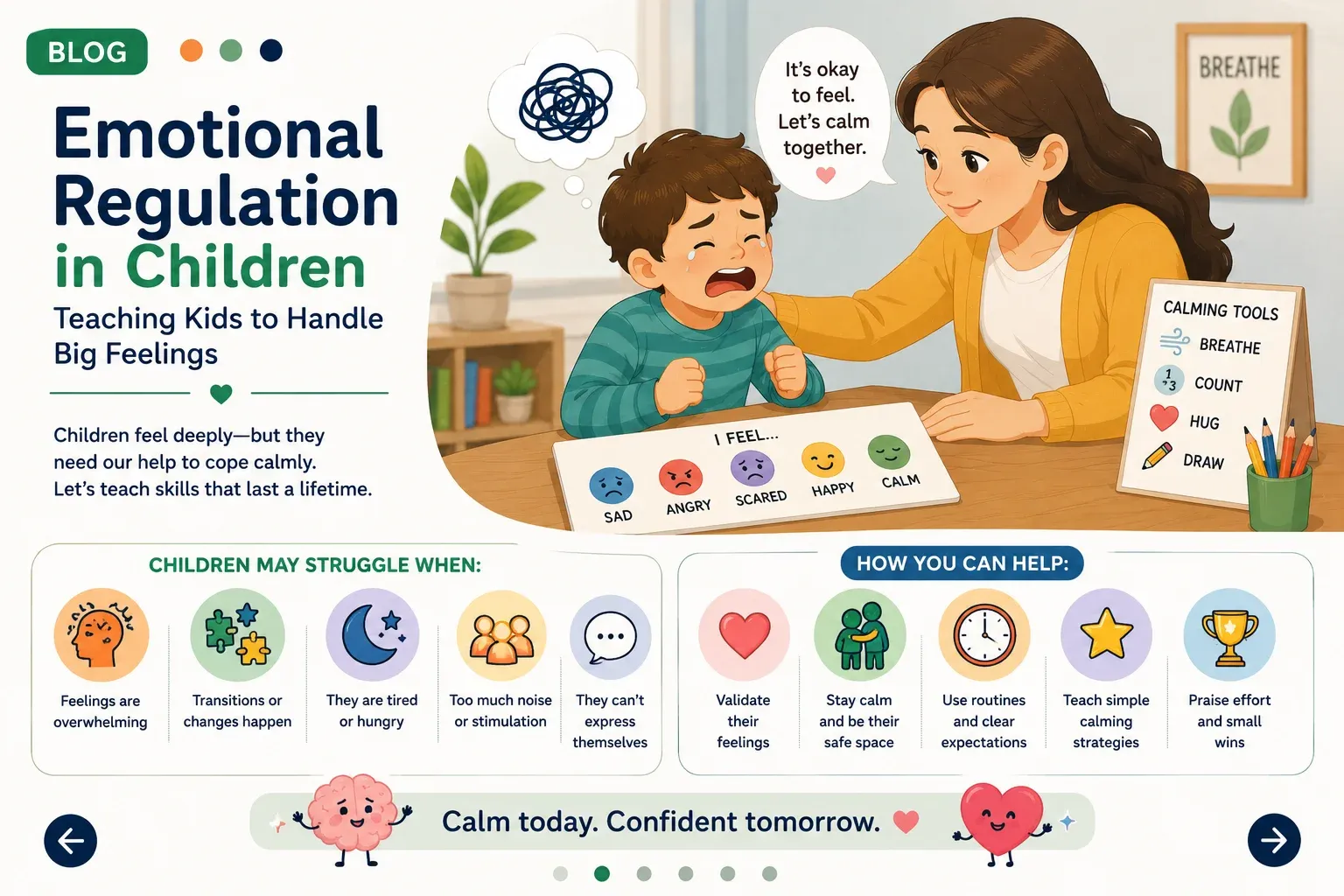
Quick Facts
In this article you'll learn
- What emotional regulation actually looks like in practice
- Why children with ADHD and autism struggle more with big feelings
- The critical difference between self-regulation and co-regulation
- Actionable home strategies to teach emotional control
- When to consult a professional for parent guidance
What is Emotional Regulation?
Emotional regulation is not about ignoring feelings or pretending to be happy all the time. It is a three-step process:
- Recognition: Realizing you are experiencing a big emotion (e.g., "I feel hot and tight—I am getting angry").
- Tolerance: Being able to sit with that uncomfortable feeling without lashing out violently.
- Recovery: Using a tool or strategy to return the nervous system to a baseline, calm state.
This is a complex neurological process. Children are not born with it; it must be taught, modeled, and practiced over many years.
Why Some Children Struggle More
If your child has ADHD, autism, or sensory processing differences, emotional regulation is naturally harder.
In ADHD, the brain's "brakes" (the prefrontal cortex) are often delayed in development. This means the emotional reaction happens instantly, before the logical brain can step in and say, "Wait, it's just a cookie."
In autism, poor emotional regulation is often the result of sensory or cognitive overload. The child's nervous system is taking in too much data from the environment, leading to a meltdown.
"My child throws fits because they are trying to manipulate me."
While some behaviour is goal-driven, true emotional dysregulation is a loss of control. The child is overwhelmed and lacks the skills to manage the intensity of their feelings.
The Power of Co-Regulation
A child cannot learn to self-regulate until they have experienced thousands of hours of co-regulation. Co-regulation means lending the child your calm nervous system when theirs is out of control.
When a child is screaming, our natural instinct is often to yell back to get them to stop. This adds fuel to the fire. Instead, co-regulation looks like:
- Dropping your volume to a whisper.
- Using very few words (language processing shuts down during stress).
- Getting down on their physical level.
- Taking deep, visible breaths yourself.
Practical Home Strategies
Building emotional regulation takes time, but you can start laying the groundwork today.
What Parents Can Do Today
- Name it to tame it: Validate their feelings out loud. 'I see you are so frustrated that the tower fell down.'
- Create a 'Calm Corner': Designate a cozy spot with sensory items (weighted blanket, fidgets) where they can go to recover. Never use it as a punishment.
- Practice deep breathing when calm: Blow bubbles or pretend to blow out birthday candles together.
- Model your own regulation: Let them see you manage frustration. 'I'm feeling stressed about traffic. I'm going to take three deep breaths.'
When to Seek Professional Support
If a child's lack of emotional regulation leads to frequent aggression, self-harm, severe school disruption, or leaves the whole family walking on eggshells, it is time to seek professional support.
A parent guidance consultation can help you build a personalized plan to reduce triggers, improve your co-regulation skills, and explicitly teach your child how to manage their inner world.
Disclaimer: This article is for educational guidance only and does not replace a professional developmental, psychological, or medical assessment. If you are concerned about your child’s development, behaviour, attention, learning, or communication, it is helpful to consult a qualified professional.
Key Takeaways
- Emotional regulation means recognizing, tolerating, and recovering from big feelings.
- Children with ADHD and autism have neurological reasons why this is much harder for them.
- You must 'co-regulate' (share your calm) before a child can learn to 'self-regulate'.
- Teach calming strategies like deep breathing only when the child is already calm.
- Model your own healthy emotional regulation out loud for your child to see.
Frequently Asked Questions
What does emotional regulation mean?
Emotional regulation is the ability to recognize you are having a big feeling, tolerate that feeling without acting out dangerously, and use a strategy to return to a calm state.
Why does my child go from 0 to 100 so fast?
Children, especially those with ADHD, often have less 'brake fluid' in their brain. Their emotional center reacts strongly before their logical brain has time to step in and apply the brakes.
How do I calm down a highly emotional child?
Before you can teach a child to calm down (self-regulation), you must share your calm with them (co-regulation). Lower your voice, reduce words, stay physically present, and breathe slowly.
Rabbia Ashraf
Clinical Psychologist | Child & Adolescent Development
Rabbia Ashraf is a dedicated Clinical Psychologist specializing in child and adolescent development. She provides parent coaching, developmental guidance, and psychoeducation.
Need Professional Guidance?
Book a consultation with Rabbia Ashraf to discuss your child's development and receive evidence-based recommendations.
Related Articles
Parent Guidance for Behaviour Concerns
When traditional discipline fails, parent guidance helps. Learn how understanding the 'why' behind behaviour and changing your response can transform your home.
Parent Burnout in Child Development Support
Supporting a child with developmental differences is exhausting. Learn why parent burnout happens and how to manage it.
Behaviour is Communication: Finding the 'Why'
Children don't act out for no reason. Learn how to map triggers and understand what your child is trying to tell you.
How to Prepare Your Child for a Psychological Assessment
Practical tips to reduce anxiety and explain testing to your child without making them feel broken.
Table of Contents
Related Articles
Parent Guidance for Behaviour Concerns
When traditional discipline fails, parent guidance helps. Learn how understanding the 'why' behind behaviour and changing your response can transform your home.
Parent Burnout in Child Development Support
Supporting a child with developmental differences is exhausting. Learn why parent burnout happens and how to manage it.
Behaviour is Communication: Finding the 'Why'
Children don't act out for no reason. Learn how to map triggers and understand what your child is trying to tell you.
How to Prepare Your Child for a Psychological Assessment
Practical tips to reduce anxiety and explain testing to your child without making them feel broken.