
Speech Delay vs. Autism: How to Tell the Difference

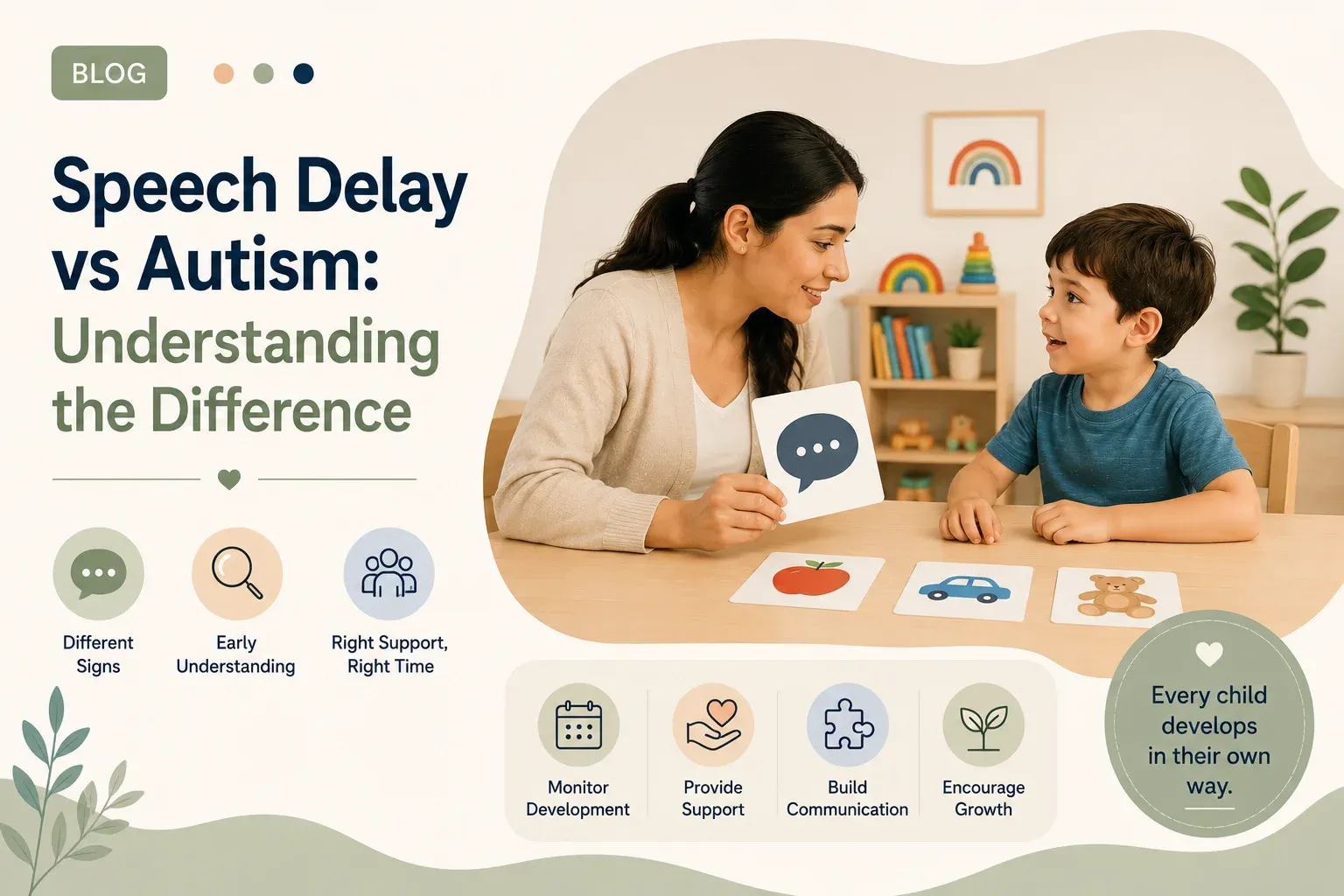
Quick Facts
In this article you'll learn
- The definition of an isolated speech delay
- How autism affects social communication, not just spoken words
- The critical concept of 'Joint Attention'
- How to observe your child's non-verbal communication
- When you should stop waiting and seek professional help
What is a Speech Delay?
An isolated speech or language delay means that a child is developing at a typical pace in motor skills, play, and social interaction, but they are behind in acquiring spoken words.
Often referred to as "late talkers," these children still have a strong desire to communicate. If they cannot find the word for "juice," they will grab your hand, walk you to the fridge, point at the juice, look you in the eye, and make a demanding noise.
When is it Autism?
Autism Spectrum Disorder (ASD) is a neurodevelopmental difference that affects the entire process of social communication, not just the mechanical act of speaking.
A child with autism may have a speech delay, but they will also show differences in the intent to communicate socially. Rather than dragging you to the fridge to point at the juice, they might simply stand by the fridge crying, or try to climb it themselves without looking to you for help.
The Importance of Non-Verbal Communication
To tell the difference between a late talker and an autistic child, professionals look closely at non-verbal communication skills.
Joint Attention
Joint attention is the ability to share focus on an object with another person. It is the invisible triangle between you, the child, and a toy.
A neurotypical late talker will point to a dog in the park, look at you to make sure you see it, and smile. An autistic child may stare intently at the dog but not attempt to share that experience with you.
Response to Name
A child with a speech delay will consistently turn their head when you call their name from across the room. A child with autism may frequently ignore their name, appearing as though they have a hearing problem (even when their hearing is fine).
"My child can say the entire alphabet, so they definitely don't have autism."
Some autistic children have advanced speech (like reciting the alphabet or scripts from movies) but still struggle with functional social communication, like saying 'I need help' or having a back-and-forth conversation.
What Parents Can Track at Home
If you are worried, spend a few days observing your child without prompting them. Write down your observations.
What Parents Can Do Today
- Does my child use pointing to show me things (not just to ask for things)?
- Does my child try to compensate for their lack of words by using gestures (waving, nodding, holding up arms to be picked up)?
- Does my child make eye contact with me to share a feeling, like looking at me to smile when something funny happens?
- Does my child respond to their name when they are occupied with a toy?
When to Seek Professional Support
If you notice that your child is lacking in non-verbal communication (like pointing and eye contact), or if they are not responding to their name by 12-15 months, it is time to seek a developmental assessment.
Even if it turns out to be "just" a speech delay, early intervention is highly effective. If it is autism, receiving early parent guidance can drastically improve your family's ability to support your child's unique developmental path.
Disclaimer: This article is for educational guidance only and does not replace a professional developmental, psychological, or medical assessment. If you are concerned about your child’s development, behaviour, attention, learning, or communication, it is helpful to consult a qualified professional.
Key Takeaways
- A speech delay affects spoken words; autism affects broader social communication.
- A child with a speech delay will usually compensate with pointing, gesturing, and strong eye contact.
- 'Joint attention' (sharing an experience without words) is a key differentiator.
- Some autistic children can speak well but struggle to use speech for social connection.
- Do not 'wait and see.' Early assessment leads to earlier support, regardless of the diagnosis.
Frequently Asked Questions
Does a speech delay mean my child has autism?
Not always. Many children are 'late talkers' but have typical social and non-verbal skills. Autism is a broader developmental difference that affects how a child communicates socially, not just whether they use spoken words.
What is the biggest difference between a late talker and an autistic child?
A late talker usually still wants to communicate socially. They will point, gesture, make eye contact, and try to share their interests with you. An autistic child may show differences in this 'joint attention' or prefer to play alone.
Should I wait to see if they start talking?
It is better to seek an assessment early. Even if it is just a speech delay, early speech therapy is highly effective. If it is autism, early parent guidance provides crucial support during critical developmental windows.
Rabbia Ashraf
Clinical Psychologist | Child & Adolescent Development
Rabbia Ashraf is a dedicated Clinical Psychologist specializing in child and adolescent development. She provides parent coaching, developmental guidance, and psychoeducation.
Need Professional Guidance?
Book a consultation with Rabbia Ashraf to discuss your child's development and receive evidence-based recommendations.
Related Articles
Autism Early Signs Parents Should Notice
A guide for parents on what to look for regarding communication, social interaction, and sensory processing differences.
Social Communication Concerns
Understanding the difference between speech delays and social communication challenges in young children.
Sensory Processing Difficulties
Understand sensory processing differences in children, how to spot sensory overload, and practical ways to create a sensory-friendly home.
Parent Guidance After an Autism Diagnosis: What Next?
You have the diagnosis, but what do you do at home? A guide to focusing on support over labels.
Table of Contents
Related Articles
Autism Early Signs Parents Should Notice
A guide for parents on what to look for regarding communication, social interaction, and sensory processing differences.
Social Communication Concerns
Understanding the difference between speech delays and social communication challenges in young children.
Sensory Processing Difficulties
Understand sensory processing differences in children, how to spot sensory overload, and practical ways to create a sensory-friendly home.
Parent Guidance After an Autism Diagnosis: What Next?
You have the diagnosis, but what do you do at home? A guide to focusing on support over labels.