
Understanding Psychological Reports: A Guide for Parents

Quick Facts
In this article you'll learn
- The standard structure of a child's psychological report
- How to understand percentiles and standard scores simply
- Why reports sound so negative (and why you shouldn't panic)
- How to translate recommendations into school accommodations
- When to seek professional help to review an old report
The Purpose of the Report
A psychological report has two main jobs: to answer the question of why a child is struggling, and to provide evidence to secure support (like an IEP or therapy funding).
Because its job is to secure support, it must legally document "impairment." This is why reports often sound very negative. It is not because your child doesn't have amazing strengths, but because "amazing strengths" do not trigger school funding.
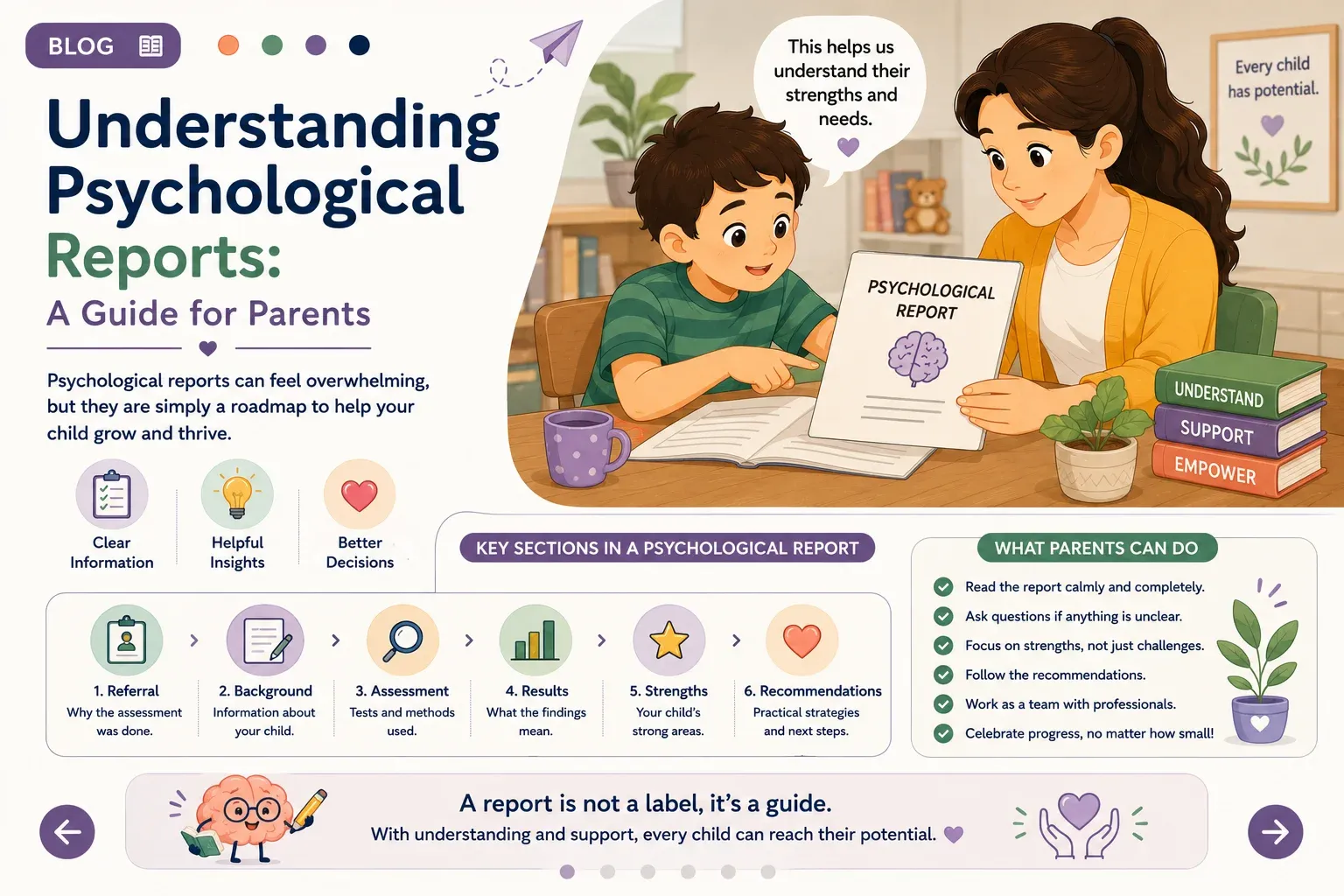
Key Sections of a Psychological Report
Most comprehensive reports follow a similar structure:
- Background History: A summary of your child's early development, medical history, and school history. (Check this section closely for factual errors).
- Behavioral Observations: How your child acted during the test. Were they anxious? Distracted? Hardworking? This provides context for the scores.
- Test Results: The hard data. This usually includes Cognitive (IQ) testing, Academic achievement, and Behavioural/Emotional questionnaires.
- Summary and Formulation: Where the psychologist pulls all the data together to explain why your child is struggling and provides any formal diagnoses.
- Recommendations: The most important section. A bulleted list of what should happen next at home, at school, and clinically.
Understanding the Numbers
Psychologists use statistics to compare your child to other children exactly their age. The most common term you will see is "Percentile."
"My child scored in the 50th percentile on reading. That's an F (50%)!"
Percentiles are not test grades. The 50th percentile means your child scored better than 50 out of 100 children their age. It is exactly average.
Generally speaking:
- 90th percentile and above: High / Superior
- 25th to 75th percentile: Average range (where most children score)
- 9th to 24th percentile: Low Average (might struggle, but not severely delayed)
- Below the 9th percentile: Very Low / Impaired (indicates a need for significant support)
How to Use the Recommendations
The recommendations section is your roadmap. However, some recommendations are vague (e.g., "Provide a quiet space"). You need to translate these into actionable school accommodations.
What Parents Can Do Today
- Highlight the top 3-4 recommendations that you feel will make the biggest immediate difference.
- Rewrite vague recommendations into specific requests for the IEP. (e.g., change 'Provide a quiet space' to 'Student will be allowed to use noise-canceling headphones during independent reading').
- Share a copy of the report (or just the summary/recommendations) with your child's teacher and the school's special education coordinator.
- Keep the original report safe. You will need it for future school transitions or funding applications.
When to Seek a Report Review
Sometimes parents receive a report from a clinic or a school, but they do not fully understand what it means for daily life, or the school refuses to implement the findings.
A Report Review consultation with a clinical psychologist can help. They can translate the jargon, explain the cognitive profile, and help you draft specific, evidence-based requests for your next school meeting.
Disclaimer: This article is for educational guidance only and does not replace a professional developmental, psychological, or medical assessment. If you are concerned about your child’s development, behaviour, attention, learning, or communication, it is helpful to consult a qualified professional.
Key Takeaways
- Psychological reports focus heavily on deficits to secure necessary funding and support.
- Percentiles are not school grades; the 50th percentile is exactly average.
- Check the background history section for any factual errors.
- The recommendations section is the most important part—use it to request specific IEP accommodations.
- If you are confused by a past report, a clinical consultation can help translate it into practical steps.
Frequently Asked Questions
What does a psychological report include?
A standard report includes the child's background history, observations during testing, the actual test results (cognitive, academic, behavioural), clinical conclusions, and a list of specific recommendations for home and school.
Why does the report focus so much on my child's weaknesses?
In order to secure funding, an IEP, or specific school accommodations, a report must clinically prove 'impairment' or a 'deficit.' It is a legal and medical document, not a complete reflection of your child's personality or potential.
Can I ask the school to follow the recommendations?
Yes. While schools are not always legally bound to follow every single recommendation from a private report, the data provides strong evidence to support your requests during an IEP or support planning meeting.
Rabbia Ashraf
Clinical Psychologist | Child & Adolescent Development
Rabbia Ashraf is a dedicated Clinical Psychologist specializing in child and adolescent development. She provides parent coaching, developmental guidance, and psychoeducation.
Need Professional Guidance?
Book a consultation with Rabbia Ashraf to discuss your child's development and receive evidence-based recommendations.
Related Articles
Homework Battles and Attention Difficulties
Why homework is a battleground for children with attention difficulties and how parents can help.

IEP and School Support Planning
A guide for parents on how to navigate IEP meetings and ensure their child receives the right support.

School Meeting Checklist
Don't go into a school meeting unprepared. Use this checklist to organize your thoughts, ask the right questions, and secure practical accommodations.
School Refusal and School Anxiety
When a child refuses to go to school, it is a sign of intense anxiety, not defiance. Learn how to support your child and communicate with the school.
Table of Contents
Related Articles
Homework Battles and Attention Difficulties
Why homework is a battleground for children with attention difficulties and how parents can help.
IEP and School Support Planning
A guide for parents on how to navigate IEP meetings and ensure their child receives the right support.
School Meeting Checklist
Don't go into a school meeting unprepared. Use this checklist to organize your thoughts, ask the right questions, and secure practical accommodations.
School Refusal and School Anxiety
When a child refuses to go to school, it is a sign of intense anxiety, not defiance. Learn how to support your child and communicate with the school.