
Executive Function Difficulties in Children: How to Support at Home

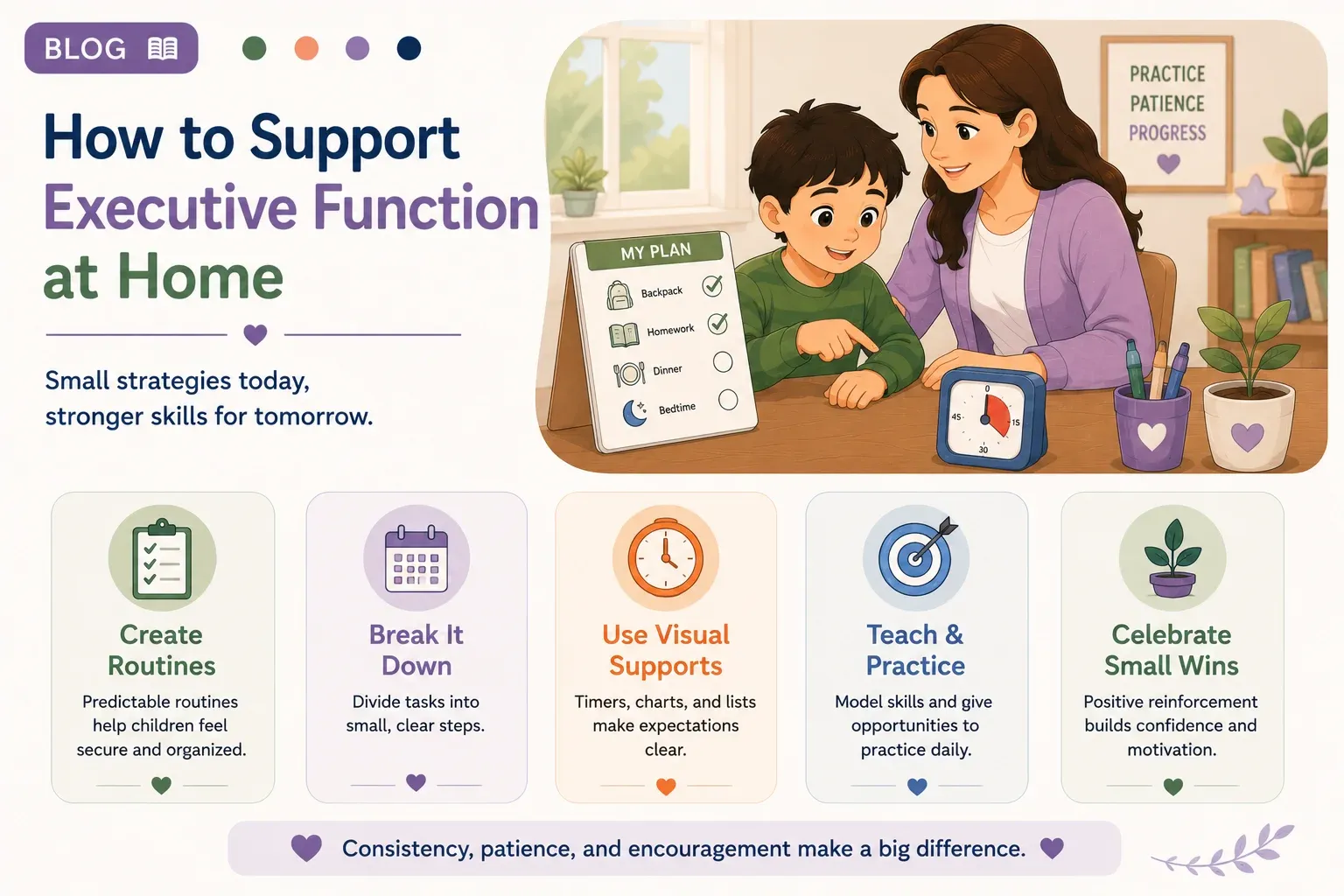
Quick Facts
In this article you'll learn
- What executive function is and why it matters
- The core areas of executive functioning
- How executive function connects to ADHD
- Practical home strategies to support your child
- When to seek an assessment
Understanding the Brain's Management System
Imagine the brain as an airport. Executive function is the air traffic control tower. It is responsible for managing arrivals, departures, preventing collisions, and keeping everything running smoothly.
When a child’s executive function skills are still developing or delayed, they may know what to do, but struggle with the how, when, and where to do it.
Core Areas of Executive Function
Executive function is an umbrella term that covers several different cognitive skills:
- Working Memory: The ability to hold information in mind while using it. (e.g., Remembering a multi-step instruction like "Go upstairs, brush your teeth, and grab your blue sweater.")
- Planning and Organization: Figuring out the steps needed to reach a goal and keeping track of materials. (e.g., Knowing what to pack in a school bag.)
- Task Initiation: The ability to begin a task without procrastinating, even if it is not highly preferred.
- Inhibition (Impulse Control): The ability to stop and think before acting or speaking.
- Time Management: Estimating how long a task will take and understanding the passage of time (avoiding "time blindness").
- Cognitive Flexibility: The ability to adapt to changes or switch between tasks smoothly.
"If a child can memorize every dinosaur name, they have great working memory and shouldn't forget their chores."
Long-term memory (facts, interests) is different from working memory (holding instructions in mind right now). A child can be brilliant at recalling facts but still struggle to remember a three-step instruction.
The Connection with ADHD
Almost all children diagnosed with ADHD experience significant difficulties with executive function. In fact, many experts consider ADHD primarily a disorder of executive functioning.
However, you do not need to have ADHD to have executive function challenges. Stress, lack of sleep, anxiety, and specific learning differences can also impact these skills.
Practical Home Strategies
The goal is to provide external "scaffolding" until the child’s internal air traffic control system is stronger.
What Parents Can Do Today
- Make time visual: Use analog clocks or visual timers (like a Time Timer) so they can 'see' time passing.
- Reduce verbal instructions: Instead of telling them 5 things to do, write a short list or use a picture chart.
- Break it down: If 'Clean your room' is too overwhelming, change it to 'Put the books on the shelf, then come tell me.'
- Use the 'Body Double' technique: Simply sitting quietly in the same room while they do homework can help them initiate and stay on task.
When to Seek Professional Support
If executive function difficulties are causing daily stress, leading to homework battles, or impacting the child's self-esteem, it may be time to seek a formal assessment or parent guidance.
A clinical psychologist can help identify specific areas of weakness and provide tailored strategies for home and school.
Disclaimer: This article is for educational guidance only and does not replace a professional developmental, psychological, or medical assessment. If you are concerned about your child’s development, behaviour, attention, learning, or communication, it is helpful to consult a qualified professional.
Key Takeaways
- Executive function is the brain's management system for planning, focus, and memory.
- Children may know what they need to do, but lack the executive skills to execute the plan.
- ADHD is closely linked to executive dysfunction.
- Externalize the skills: use visual timers, written checklists, and break tasks down into micro-steps.
- Professional support can help clarify the specific challenges and provide a roadmap.
Frequently Asked Questions
What is executive function?
Executive function refers to the brain's 'management system.' It involves the mental skills needed to plan, focus attention, remember instructions, and juggle multiple tasks successfully.
Is executive dysfunction the same as ADHD?
Almost all children with ADHD have executive function difficulties, but you do not need an ADHD diagnosis to struggle with executive function. Things like stress, lack of sleep, or learning differences can also impact it.
How can I help my child remember instructions?
Break instructions down into single steps. Use visual checklists instead of giving multiple verbal commands at once, and ask your child to repeat the instruction back to you to ensure it was processed.
Rabbia Ashraf
Clinical Psychologist | Child & Adolescent Development
Rabbia Ashraf is a dedicated Clinical Psychologist specializing in child and adolescent development. She provides parent coaching, developmental guidance, and psychoeducation.
Need Professional Guidance?
Book a consultation with Rabbia Ashraf to discuss your child's development and receive evidence-based recommendations.
Related Articles
Morning Routine Problems in ADHD
Mornings are often the hardest part of the day for families with ADHD. Understand the executive function struggles behind morning chaos and learn practical parent strategies.
Homework Battles and Attention Difficulties
Why homework is a battleground for children with attention difficulties and how parents can help.
Understanding the Confusion Between ADHD and Hyperactivity in Children
Not every child with ADHD is visibly hyperactive. Some children struggle more with attention, organization, forgetfulness, or impulsivity.
Screen Time and Emotional Regulation
Understand the neurological reasons behind screen-time meltdowns and learn practical parent strategies to manage transitions without the battle.
Table of Contents
Related Articles
Morning Routine Problems in ADHD
Mornings are often the hardest part of the day for families with ADHD. Understand the executive function struggles behind morning chaos and learn practical parent strategies.
Homework Battles and Attention Difficulties
Why homework is a battleground for children with attention difficulties and how parents can help.
Understanding the Confusion Between ADHD and Hyperactivity in Children
Not every child with ADHD is visibly hyperactive. Some children struggle more with attention, organization, forgetfulness, or impulsivity.
Screen Time and Emotional Regulation
Understand the neurological reasons behind screen-time meltdowns and learn practical parent strategies to manage transitions without the battle.