
Why Is It Hard for Children to Stop Screen Time?

Quick Facts
In this article you'll learn
- Why screens are so hard to turn off
- How dopamine affects your child's brain
- What an 'extinction burst' is
- How to make transitions easier
- Why replacing the reward is key
It is important to understand that screen time is not only a behaviour issue.
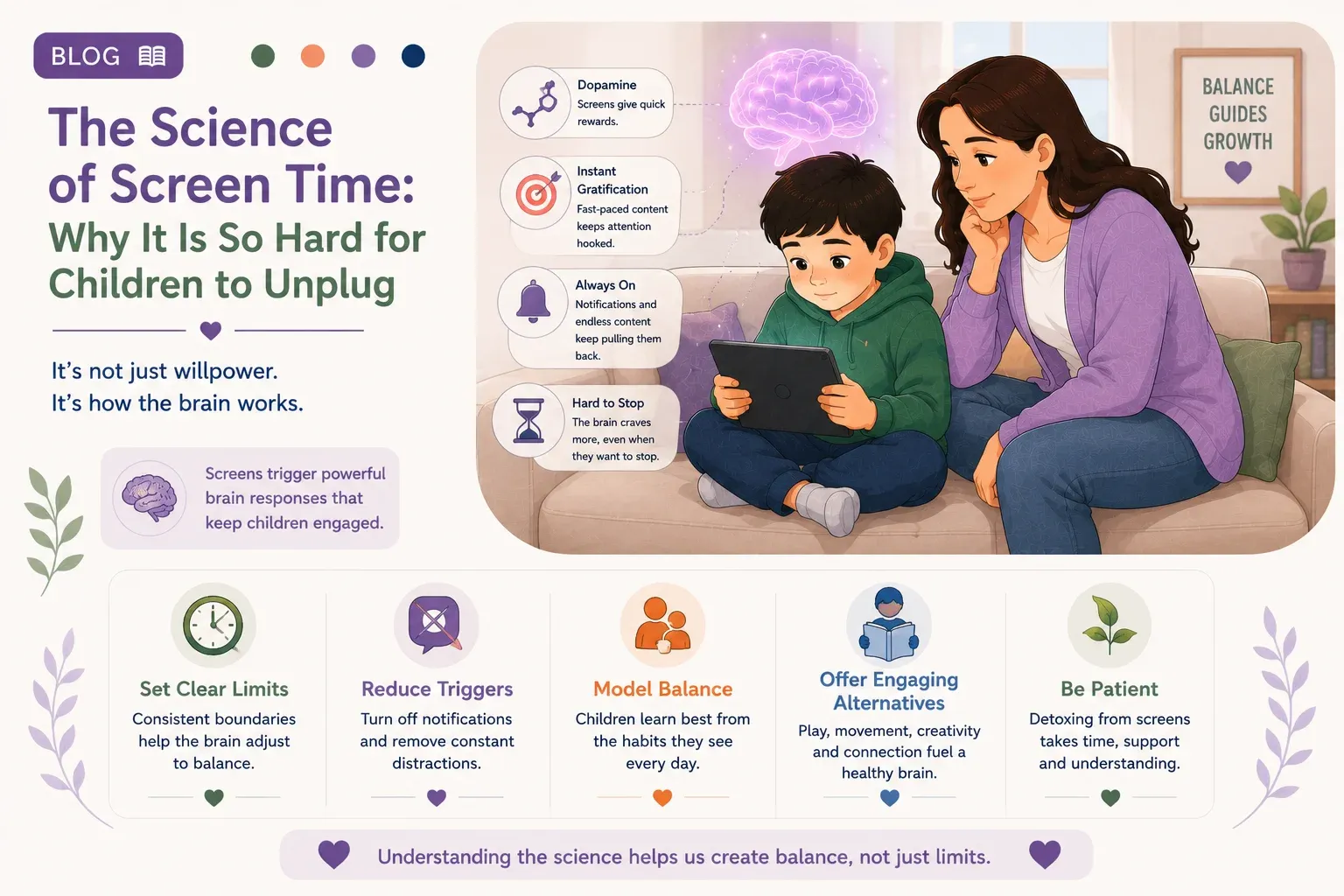
Screens are highly stimulating. They are designed to hold attention, give quick rewards, and keep the child engaged.
For many children, stopping screen time can feel very hard.
The Brain Likes Fast Rewards
Screens provide quick stimulation.
A child may win a game, unlock a new level, or watch a funny video.
These experiences activate the brain’s reward system by releasing dopamine.
This makes the child want to repeat the activity again and again.
Screens Can Become a Coping Tool
For some children, screen time is not only entertainment.
It becomes a way to avoid boredom, frustration, anxiety, or difficult tasks.
When screens are used repeatedly to escape uncomfortable feelings, the child may become dependent on them.
Then, when the screen is removed, the uncomfortable feeling returns, and the child reacts strongly.
The Power of Desire
Desire is especially powerful during screen time.
When a child wants more screen time, you may notice difficulty listening, anger when interrupted, or difficulty shifting attention.
This means transitions away from screens require structure and consistency.
Why Tantrums May Get Worse Before They Improve
One reason screen-time limits are difficult is a behaviour pattern known as an extinction burst.
This happens when a behaviour that used to get a reward suddenly stops working.
At first, the child may increase the behaviour (crying louder) to try harder to get the reward back.
"If I just let them finish the game, they will turn it off without a fuss."
Giving in to protests teaches the child that tantrums work, making the next transition even harder.
How Parents Can Make Screen Transitions Easier
Parents do not need to remove screens completely.
The goal is to create healthy structure around screen use.
What Parents Can Do Today
- Set screen rules before the screen starts.
- Use a visual timer or countdown.
- Give warnings before transition time (e.g., '5 more minutes').
- Keep meals and homework screen-free.
- Offer a planned activity immediately after screen time.
Replace the Reward, Do Not Only Remove It
If screen time is removed but nothing else is available, the child may feel restless or bored.
Parents should slowly build non-screen rewards into the child’s routine, such as outdoor play, board games, or sensory play.
Seek professional advice if your child
- •Shows daily aggression when screens are removed
- •Has severe sleep problems due to screens
- •Refuses to attend school or do homework
- •Withdraws entirely from social or family life
Key Takeaways
- Screens release dopamine, making them hard for a child's brain to turn off.
- Tantrums during transitions are common because the child's reward is abruptly removed.
- Giving in to a tantrum reinforces the behaviour (extinction burst).
- Visual timers and clear warnings help the brain prepare to stop.
- Always have an engaging 'next activity' ready when screen time ends.
Frequently Asked Questions
Why does my child have a tantrum when I turn off the screen?
Screens activate the brain's reward system. When the screen is removed, the child loses that fast stimulation, causing frustration.
Should I just take the screen away completely if they act out?
Not necessarily. Sudden complete removal without warning can trigger severe meltdowns. It is often better to use visual timers and give warnings.
Rabbia Ashraf
Clinical Psychologist | Child & Adolescent Development
Rabbia Ashraf is a dedicated Clinical Psychologist specializing in child and adolescent development. She provides parent coaching, developmental guidance, and psychoeducation.
Need Professional Guidance?
Book a consultation with Rabbia Ashraf to discuss your child's development and receive evidence-based recommendations.
Related Articles
Screen Time and Emotional Regulation
Understand the neurological reasons behind screen-time meltdowns and learn practical parent strategies to manage transitions without the battle.

Parent Guidance for Behaviour Concerns
When traditional discipline fails, parent guidance helps. Learn how understanding the 'why' behind behaviour and changing your response can transform your home.
Sleep Routine and Child Behaviour
How sleep impacts behaviour, emotional regulation, and attention, plus practical strategies for better bedtime routines.
Behaviour is Communication: Finding the 'Why'
Children don't act out for no reason. Learn how to map triggers and understand what your child is trying to tell you.
Table of Contents
Related Articles
Screen Time and Emotional Regulation
Understand the neurological reasons behind screen-time meltdowns and learn practical parent strategies to manage transitions without the battle.
Parent Guidance for Behaviour Concerns
When traditional discipline fails, parent guidance helps. Learn how understanding the 'why' behind behaviour and changing your response can transform your home.
Sleep Routine and Child Behaviour
How sleep impacts behaviour, emotional regulation, and attention, plus practical strategies for better bedtime routines.
Behaviour is Communication: Finding the 'Why'
Children don't act out for no reason. Learn how to map triggers and understand what your child is trying to tell you.